The Florida city with the biggest buzz may be the wrong fit for your investment strategy. The best cities for Florida real estate investment depend on what you’re buying, how you plan to earn returns, and which risks you’re prepared to manage. With Florida’s market rebalancing, a statewide ranking can’t tell you how a specific city or property will fit your goals.
It’s reasonable to want a clear shortlist, especially when prices, rents, and conditions can vary widely across the state. Zillow reported 175,123 homes for sale and a median 48 days to pending statewide as of August 31, 2026, but those figures don’t replace local due diligence. Insurance costs, flood exposure, property condition, and applicable regulations can all affect a deal’s outlook.
This practical comparison will help you weigh Florida markets against your budget and investment goals, using current, comparable evidence rather than outdated claims or one-size-fits-all rankings. You’ll also see how residential and commercial investments call for different considerations, what local risks to check, and which details to verify before making an offer or speaking with a broker. The aim is a focused shortlist, and a clearer basis for deciding where to look next.
Key Takeaways
- The best cities for Florida real estate investment depend on your strategy, target property, time horizon, and comfort with local risks.
- Compare Miami, Fort Lauderdale, Palm Beach, Stuart, Port St. Lucie, Vero Beach, and Melbourne by the property types and market conditions that suit your goals.
- Assess residential rentals, multifamily, commercial property, and new construction on their own merits, including the different due diligence and operating demands each involves.
- Use consistent dates, data definitions, and property types when comparing market indicators so your shortlist rests on like-for-like evidence.
- Build a focused two- or three-city shortlist, then identify the property-specific questions to resolve before making an offer or speaking with a broker.
How to identify the best Florida cities for real estate investment in 2026
No single Florida city is best for every investor. A strong-fit market aligns with your investment strategy, property type, time horizon, and tolerance for risk. That may point one buyer toward rental income and another toward a commercial property or a home they plan to use themselves.
Investment-market fit is the alignment between a market’s evidence and the investor’s goals, property type, holding period, and capacity for risk. Use that definition to look past broad rankings. Measurable evidence, such as dated sales or rental data with a clear definition, can help you compare markets; forecasts and promotional claims are opinions to examine, not guarantees. Personal preference matters too, but it shouldn’t substitute for checking the numbers and the specific property.
City-level averages are useful for deciding where to investigate, not for predicting an individual property’s performance. Neighborhood conditions, building condition, insurance, flood exposure, and local requirements can change the picture. Consider a market’s economic context as well: this overview of Florida’s economic drivers provides background on sectors that can influence real estate demand, including tourism, agriculture, and international trade.
What does best mean for a Florida property investor?
Start with the outcome you want: rental income, potential long-term appreciation, portfolio diversification, or a property you’ll also use. Then set a realistic holding period, decide how much property management you can take on, and define the risks you’re willing to accept. A market that suits one set of priorities may not suit another. Performance is uncertain and depends on the specific property, its costs, and how market conditions develop.
Which Florida markets belong on an initial shortlist?
Begin with markets to investigate, not presumed winners. Miami and Fort Lauderdale offer South Florida comparison points; Palm Beach, Stuart, Port St. Lucie, Vero Beach, and Melbourne broaden the search along the coast. Compare the same property types and date ranges in each city, then narrow your list based on your goals and evidence. For a practical framework, see this Florida real estate investment metrics guide.
Before comparing listings, write down your intended asset type, target return priorities, time horizon, and key risk concerns. That short profile gives each city a consistent test and helps separate a promising fit from a compelling-sounding headline. The following comparison can then help you decide where deeper property-level research makes sense.
Miami to Melbourne: compare Florida investment cities by market fit
Think of this as a research map, not a ranking. The best cities for Florida real estate investment depend on the property and strategy you’re evaluating, so treat each market angle below as a question to investigate rather than a promise about rent, growth, or returns. Compare the same property types and reporting periods, and check local employment using Florida economic data from FloridaCommerce alongside dated housing, rental, and commercial sources.
| City | Asset types to investigate | Market evidence to compare | Key diligence questions |
|---|---|---|---|
| Miami | Residential, multifamily, commercial | Neighborhood-level sales, rents, employment, and commercial activity | How do insurance, flood exposure, property condition, and local requirements affect the specific deal? |
| Fort Lauderdale | Residential, multifamily, commercial | Comparable rental and sales data, local jobs, and commercial indicators | Does the property’s location and condition support your intended use? |
| Palm Beach | Residential and commercial properties | Like-for-like listings, transactions, rents, and employment trends | Do acquisition assumptions fit your budget and risk tolerance? |
| Stuart | Residential and commercial properties | Local housing supply, rents, employment, and property demand | What supports demand for this asset in its immediate area? |
| Port St. Lucie | Residential, multifamily, new construction | Supply, comparable rents and sales, employment, and infrastructure plans | Could competing supply affect the property’s prospects? |
| Vero Beach | Residential and commercial properties | Local transactions, rental evidence, jobs, and commercial activity | Are comparable properties truly similar in location and condition? |
| Melbourne | Residential, multifamily, commercial | Employment, housing supply, rents, and relevant commercial indicators | Does local property-level demand support your planned holding period? |
How South Florida cities may serve different investment strategies
Miami, Fort Lauderdale, and Palm Beach make useful comparisons, but avoid assuming their buyers, tenants, or property demand are interchangeable. Add Hollywood and Palm Beach Gardens when they fit your search area, then compare the same asset class, neighborhood scale, and time period. SFR Analytics reported a 7.95% gross rental yield for the Miami-Fort Lauderdale-West Palm Beach metro in July 2026; that metro figure isn’t a city-level forecast or a property-specific return. For added Miami context, read the Miami real estate market trends guide.
What to investigate across Stuart, Port St. Lucie, Vero Beach, and Melbourne
Compare these Treasure Coast and Space Coast markets with consistent definitions and reporting periods. Check local employment, housing supply, infrastructure information, and demand for the specific property type using credible, dated sources. City averages can frame a search, but they can’t predict an individual property’s performance. A focused review of a target city and asset can help clarify which questions to resolve before pursuing an acquisition. Florida Commercial Investment Properties provides brokerage and sales guidance across these markets; explore property acquisition guidance as you refine your comparison.
Which Florida city fits your property type, return goals, and risk tolerance?
A popular city isn’t automatically a strong investment. A market’s reputation can’t tell you whether a particular property’s income will cover its costs, how long it may take to find a tenant, or how easily you could sell when your plans change. Compare potential income, vacancy exposure, liquidity, management demands, and ownership risks for the property type you’re actually considering.
Each asset class calls for a different lens:
- Residential rentals: Compare achievable rents with vacancy, maintenance, tenant turnover, and the time or support needed to manage the property.
- Multifamily: Assess demand across the units, operating needs, building condition, and the effect of vacancies on income.
- Commercial property: Examine the specific asset class, location, tenant fundamentals, and lease-related assumptions. Commercial demand varies by property and submarket.
- New construction: Verify development status, delivery terms, comparable supply, and whether the expected timing fits your holding period.
None is universally superior. The right comparison depends on what you’re prepared to manage and what evidence supports the property’s intended use. For a closer look at trade-offs, review this Florida commercial and residential investment comparison.
How residential and commercial strategies change the city shortlist
Start with the likely tenant or buyer, then test whether local evidence supports demand for that use. A residential rental search might focus on comparable rents and vacancy conditions; a commercial search needs evidence relevant to its particular asset class, location, and tenant base. Match the expected ownership responsibilities and holding period to your capacity. For new construction, confirm project status and delivery terms, and compare upcoming supply before relying on projected demand.
How to balance income potential with Florida-specific ownership risks
Ground your assumptions in the exact property. Check insurance availability and request property-specific quotes before estimating returns. Review FEMA flood maps and local flood information, while recognizing that neither alone is a complete risk assessment. Verify property taxes, applicable local rules, and likely maintenance needs. Have qualified professionals review financing assumptions and other deal-specific questions; don’t treat a citywide average as a substitute for that diligence.
These checks can change which of the best cities for Florida real estate investment belongs on your shortlist. A market that looks attractive at a glance may not fit once operating demands, insurance, potential vacancy, and exit flexibility are considered. Compare properties against the same priorities, then focus on the locations where the evidence and your capacity align.
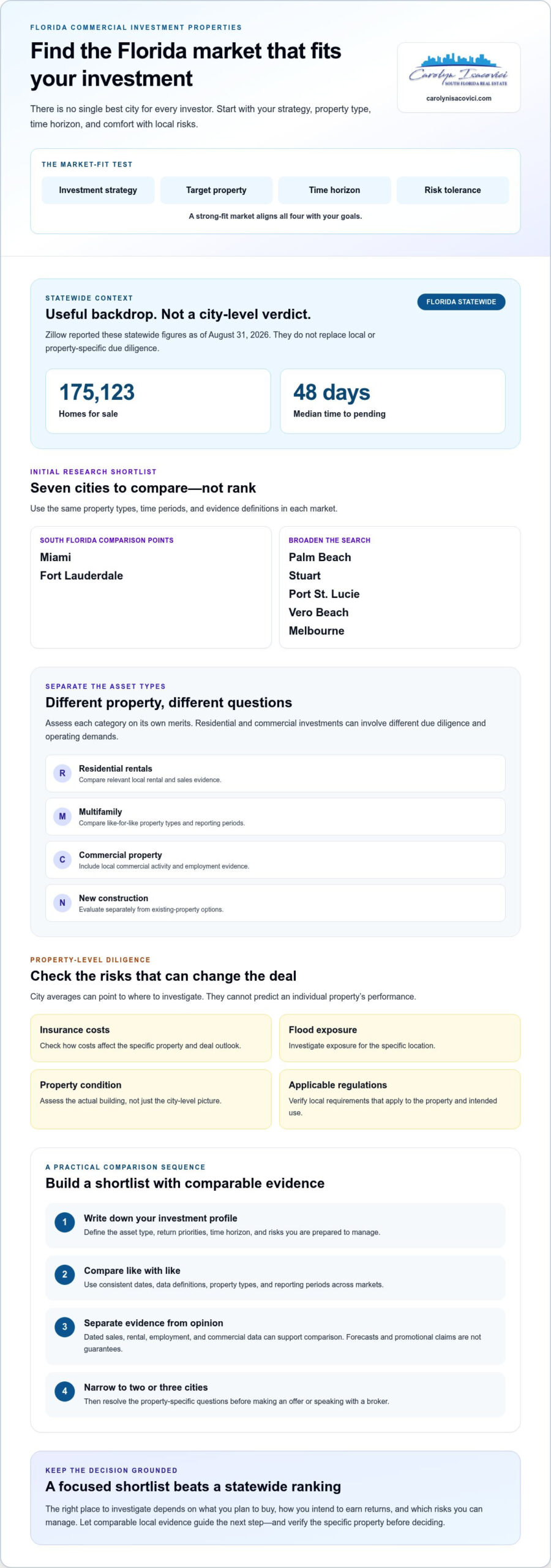
A step-by-step checklist for researching Florida investment cities
A consistent process makes city comparisons more useful and helps you spot where the evidence is incomplete. Use these steps to move from broad research to property-specific questions before you make an offer.
- Set your investment parameters. Record your target property type, objectives, expected holding period, management capacity, and tolerance for risk.
- Choose candidate cities. Keep the initial list focused on markets with plausible options for your strategy, rather than ranking every Florida city.
- Gather comparable data. For each indicator, use the same date range, geography, definitions, and property type. Label every figure with its source and reporting period.
- Check economic context. Consult current U.S. Census Bureau population information and local economic data, including employment indicators, to understand the communities you’re comparing.
- Review property-market evidence. Compare dated housing supply, sales activity, rental information, and relevant commercial indicators from credible sources. Don’t treat different measures or time periods as interchangeable.
- Screen location risks. Review FEMA flood maps, NOAA hazard information, local records, zoning, taxes, and applicable rules. Confirm questions with local authorities and qualified advisers.
- Evaluate specific properties. Investigate insurance terms, property condition, maintenance needs, and other deal-specific assumptions. Keep city research separate from inspections, title review, legal advice, and financial underwriting.
What current data should investors compare between Florida cities?
Use current population and employment context from the U.S. Census Bureau and local economic sources, then compare housing supply, rents, sales activity, and commercial indicators relevant to your target asset. Record the geography, time period, property type, definition, and source beside every statistic. This simple discipline helps prevent a metro-wide measure from being mistaken for neighborhood-level evidence or a city figure from being applied to a different property type.
What risks must be checked before choosing a Florida property?
Check FEMA flood mapping and NOAA hazard information, but don’t treat either as a complete property risk assessment. Confirm insurance availability and terms for the specific address, and review local records for zoning, permitting, taxes, and relevant requirements. Property condition and maintenance also need direct evaluation. Bring questions to qualified professionals, since a city-level screen can’t replace inspections, legal advice, title review, or financial analysis.
City screening narrows the search, but it doesn’t replace property due diligence. Once your research points to a few plausible locations, organize the unresolved questions by property and seek appropriate guidance before moving forward. To discuss your target Florida cities and property type, explore investment property sales guidance.
Turn your Florida city shortlist into a focused property search
Research becomes more useful once it leads to a manageable set of places and clear property criteria. Choose two or three cities that meet your priorities, then compare actual opportunities against the same standards. The best cities for Florida real estate investment are only a starting point: a city’s profile can’t establish whether a particular property fits your objectives or will perform as hoped.
Before contacting a broker, prepare a short brief that covers:
- Target locations: Your preferred cities, plus any alternatives you’d consider if the evidence points elsewhere.
- Asset class: Residential, commercial, investment property, or new construction, with any important property characteristics.
- Investment objectives and timeframe: What you hope the property will support and how long you expect to hold it.
- Preferred involvement: How much time and attention you can devote to ownership and property operations.
- Open diligence questions: Concerns about insurance, flood exposure, condition, local requirements, or assumptions that still need verification.
A focused brief helps make conversations about property discovery and acquisition more productive. Ask how potential listings and local market context will be assessed against your criteria, and clarify what brokerage guidance covers. Keep lending, legal, tax, and property-management questions with appropriately qualified providers.
When to expand or narrow the Florida search
Keep more than one city in consideration if several meet your evidence-based criteria and offer relevant properties to investigate. Narrow the list if property-level risks, ownership costs, or local requirements conflict with your goals. Revisit your assumptions as market data, property availability, and your own circumstances change. A shortlist is a working tool, not a commitment to buy in a particular location.
Then evaluate each candidate on its own merits. Compare the property’s condition, location, costs, and relevant demand evidence with your plan, and resolve outstanding diligence questions before making a decision. A local brokerage can help you explore property options and navigate acquisition, but no city or broker can guarantee an investment outcome.
If you’re ready to discuss your target locations and property type, discuss your Florida investment property search.
Make Your Florida Property Search More Focused
The best cities for Florida real estate investment aren’t universal winners; they’re markets that align with your goals, preferred property type, timeline, and tolerance for risk. Use city comparisons to build a focused shortlist, then test each opportunity with current, comparable evidence. Insurance, flood exposure, property condition, and local requirements deserve attention at the property level, not just in a city overview.
A clear brief can help you move from research to a practical search. Identify your target asset class, investment objectives, timeframe, and outstanding diligence questions before evaluating specific properties. That gives you a sound basis for discussing local fit and acquisition options.
Florida Commercial Investment Properties provides brokerage and sales guidance for commercial, residential, investment, and new-construction properties, with a stated service area across South Florida and Treasure Coast communities. If you’re ready to explore your options, discuss your Florida investment property search.
A thoughtful shortlist won’t remove uncertainty, but it can help you take the next step with greater clarity and confidence.
Frequently Asked Questions
What are the best cities in Florida for real estate investment?
There’s no universal winner. Miami, Fort Lauderdale, Palm Beach, Stuart, Port St. Lucie, Vero Beach, and Melbourne can all be considered, but the right shortlist depends on your property type, goals, holding period, and risk tolerance. Compare current local data using consistent definitions, then assess each property on its own merits. Rankings and forecasts can help guide research, but they can’t guarantee future performance.
Is Florida a good state for real estate investment in 2026?
Florida may suit some investment strategies, but statewide appeal doesn’t make every market or property a fit. Research local demand, supply, ownership costs, insurance, flood exposure, taxes, and applicable rules for the specific location and property. Use current, credible sources instead of relying on statewide averages alone. Before making an acquisition decision, consider discussing open questions with qualified local professionals who can address the relevant parts of your review.
Which Florida cities are worth comparing for rental property investment?
Start with cities that match your target property type and intended tenant, then compare current rental evidence and ownership costs. Depending on your search area, candidates may include Miami, Fort Lauderdale, Palm Beach, Stuart, Port St. Lucie, Vero Beach, and Melbourne. Check rents, vacancy, insurance, taxes, and local requirements for each property. Citywide figures may not reflect conditions in a particular neighborhood or the performance of an individual asset.
Are Miami or Fort Lauderdale better for real estate investment?
Neither city is automatically better for every investor. Compare the specific asset class, likely tenant or buyer demand, acquisition assumptions, ongoing costs, insurance, and property-level risks. Use recent local data with consistent definitions, then evaluate actual properties rather than relying on a city’s reputation. Miami may fit one strategy, while Fort Lauderdale or another Florida market may better match a different budget, timeframe, property type, or management approach.
How do I compare Florida cities before buying an investment property?
Define your goals and target property type first. Then compare cities using the same reporting periods and data definitions for demand, supply, rents or sales, employment, and ownership costs. Screen flood exposure, insurance, taxes, zoning, and local requirements. Once you’ve narrowed the best cities for Florida real estate investment for your strategy, investigate individual properties with qualified professionals. City research is a useful filter, but it can’t establish a property’s likely performance.
What Florida investment property risks should I check before buying?
Review insurance availability and terms, flood exposure, property condition, taxes, zoning, and applicable local requirements. FEMA flood maps, NOAA hazard information, local authorities, insurers, and qualified professionals can help you investigate different risks. These sources are screening tools, not complete property assessments or substitutes for professional advice. Include realistic operating assumptions in your analysis, and verify property-specific details before making an offer so you understand the questions that could affect ownership.
Can an out-of-state investor buy Florida investment property?
Out-of-state investors can explore Florida property purchases, but should plan carefully for local research and ongoing ownership. Verify property information, arrange appropriate inspections and professional reviews, and consider how leasing, maintenance, insurance, taxes, and local requirements will be handled. A Florida brokerage can assist with property discovery and transaction navigation. That guidance doesn’t replace legal, tax, lending, or property-management advice from qualified providers in those fields.