
What if the most stressful 45 days of your investment career became your greatest opportunity for portfolio growth? Many experienced investors view the IRS clock with a sense of dread, fearing that the pressure to find quality 1031 exchange properties Miami will lead to a rushed or sub-optimal decision. It’s a valid concern in a landscape where industrial vacancies sit below 3 percent and prime Class A office space remains highly competitive. You aren’t alone in feeling that the stakes for your capital have never been higher.
We’re here to transform that uncertainty into a strategic advantage. This guide will help you master the complexities of tax-deferred exchanges and identify high-yield replacement properties in the 2026 Miami market. You’ll learn how to defer 100 percent of your capital gains taxes while transitioning into lower-maintenance assets that truly perform. We’ll explore the latest 2026 regulatory shifts, clarify like-kind definitions across different asset classes, and provide a clear roadmap for scaling your Florida real estate portfolio with confidence and clarity.
Key Takeaways
- Learn how to defer 100 percent of capital gains taxes to maximize your reinvestment power in the 2026 market.
- Discover why the definition of like-kind property is broader than most investors realize, giving you the flexibility to pivot between diverse asset classes.
- Master the specific criteria for identifying high-yield 1031 exchange properties Miami by analyzing current cap rates and the demand for industrial space.
- Understand the strict IRS deadlines to ensure you identify and close on your replacement properties within the mandatory 45-day and 180-day windows.
- Explore how local brokerage expertise helps you secure off-market commercial opportunities that aren’t available to the general public.
Understanding the 1031 Exchange Landscape in Miami (2026)
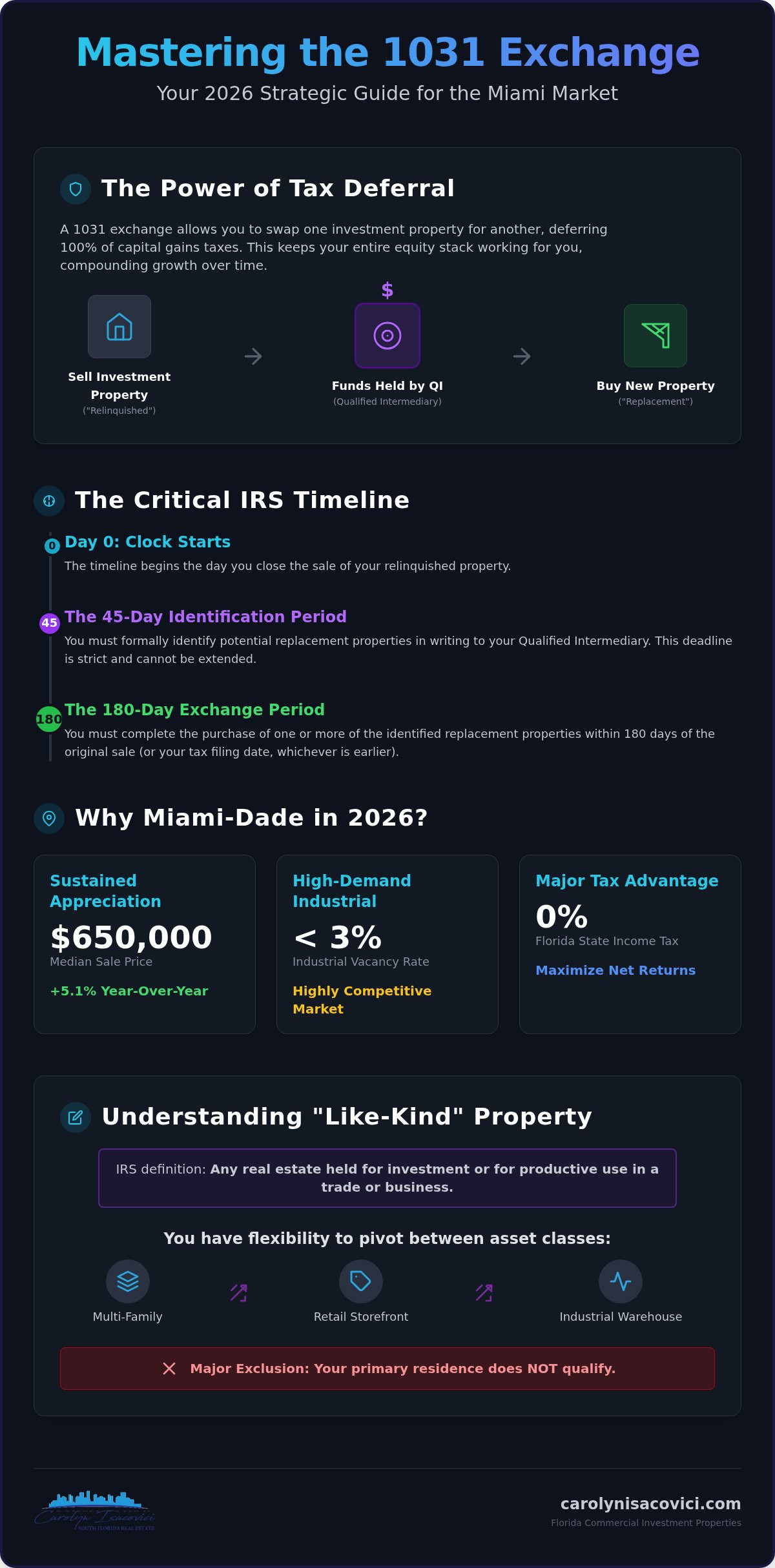
Why leave money on the table when you can reinvest it? The mechanism provided by Internal Revenue Code section 1031 remains one of the most potent tools for wealth preservation in your real estate career. In essence, it allows you to swap one investment property for another while deferring 100 percent of your capital gains taxes. This keeps your entire equity stack working for you rather than being diminished by immediate tax liabilities. In the 2026 market, where 1031 exchange properties Miami are in high demand, understanding this landscape is the first step toward a more resilient and profitable portfolio.
You need to distinguish between your partners in this journey. While a Qualified Intermediary (QI) is legally required to hold your exchange funds to avoid “constructive receipt,” a specialized real estate broker is your boots-on-the-ground strategist. Your broker identifies the inventory that meets your yield requirements before the clock runs out. We focus on bridging the gap between tax compliance and high-performance acquisition, ensuring your capital moves into assets that offer long-term stability.
Why Investors are Targeting Miami-Dade in 2026
Why does South Florida continue to dominate the national conversation? It’s about more than just the lifestyle. As of July 2026, Miami’s median sale price reached $650,000, representing a 5.1 percent increase year-over-year. Single-family homes have seen even steadier climbs to a median of $685,000. This sustained appreciation, combined with Florida’s lack of state income tax, makes the region a primary hub for tax-deferred exchanges. You can explore the deeper nuances of these shifts in our guide to Miami real estate market trends. The “flight to quality” in the office sector and the sub-3 percent industrial vacancy rates create a competitive but rewarding environment for those seeking 1031 exchange properties Miami.
The Financial Impact of Tax Deferral
Think of tax deferral as an interest-free loan from the government. By deferring taxes, you aren’t just saving money today; you’re compounding your growth over several decades. This strategy is particularly effective for estate planning, as it can facilitate a “step-up in basis” for heirs, potentially eliminating the deferred tax liability entirely. Additionally, as federal bonus depreciation is scheduled to drop to 20 percent in 2026, maximizing your reinvestment power through an exchange becomes a critical hedge against changing fiscal policies. It’s about moving from a “sell and pay” mindset to a “swap and grow” philosophy. This approach allows you to scale your holdings into larger, more stable commercial assets without the friction of a massive tax bill.
Like-Kind Property Rules and Florida Tax Advantages
Have you ever wondered if your residential rental could become a commercial powerhouse? Many investors feel limited by the assets they currently hold. The reality is that IRS rules on like-kind exchanges are far more flexible than they appear. Like-Kind property is any real estate held for investment or business use. This means you aren’t restricted to swapping a condo for another condo. You can trade a multi-family apartment building for a high-yield industrial warehouse or move from a single-family rental into a retail storefront. The only major exclusion to remember is your primary residence. Personal homes don’t qualify because they aren’t held for productive use in a trade or business.
Qualified Intermediaries (QI) and Safe Harbors
Why is the QI so essential? You cannot touch the sale proceeds at any point during the transaction. If the funds hit your personal bank account, the IRS considers it “constructive receipt,” and the tax deferral is lost. Selecting a QI with deep local Florida expertise ensures your transaction follows the strict “Safe Harbor” guidelines. These rules provide a clear, protected path to complete your exchange without triggering an audit. It’s about maintaining a clean paper trail from the moment your relinquished property closes until you secure new 1031 exchange properties Miami.
Florida-Specific Investment Incentives
Why choose Florida over other states? The absence of a state income tax creates a double benefit when combined with a 1031 exchange. When you compare the net returns of a Miami asset to similar properties in high-tax states like New York or California, the difference in take-home yield is often startling. You aren’t just deferring federal taxes; you’re operating in an environment designed for growth. If you are looking to scale, reviewing current Florida commercial real estate for sale can reveal opportunities that simply don’t exist in more restrictive markets. Our team can help you analyze these local advantages to find the perfect fit for your portfolio.
Commercial vs. Residential: Identifying High-Yield 1031 Assets
Which asset class aligns best with your portfolio’s next chapter? Selecting the right replacement property requires a delicate balance between immediate yield and long-term stability. In the 2026 market, industrial properties remain a standout choice for those seeking 1031 exchange properties Miami. With vacancy rates in prime corridors sitting below 3 percent and average asking rents ranging from $12 to $18 per square foot NNN, the demand for logistics and warehouse space is undeniable. These metrics make industrial assets some of the most resilient options for investors looking to protect their capital while maintaining steady cash flow. For those seeking passive ownership in institutional-grade real estate, Cornerstone Real Estate Investment Services offers specialized access to Delaware Statutory Trust (DST) properties.
Analyzing cap rates is equally vital. While the first quarter of 2026 saw some cooling in sales volume due to interest rate pressures, the underlying demand for quality Miami real estate keeps cap rates competitive. We focus on identifying properties where the risk-adjusted return justifies the acquisition, ensuring your exchange leads to a stronger financial position than the one you left behind.
Are you looking beyond the Miami city limits? Fort Lauderdale and Hollywood have emerged as significant hubs for retail and office space. We’ve seen a particular rise in the stability of medical office buildings. These assets often feature long-term tenants and recession-resistant demand, providing a secure harbor for your capital. For a deeper dive into how these sectors stack up, explore our Commercial vs Residential Investment Florida comparison. The “flight to quality” remains the dominant trend, especially in the office sector where Class A spaces command rents over $70 per square foot.
Residential Investment Strategies
Is residential still a viable path for high-yield returns? Absolutely. The multifamily sector continues to show remarkable resilience with average occupancy rates holding steady between 94 and 96 percent. Investors are also increasingly pivoting toward new construction homes Florida. These properties offer a compelling low-maintenance play, allowing you to scale your portfolio without the burden of immediate capital expenditures or aging infrastructure. Whether you are targeting short-term rental potential in coastal areas or long-term multi-family holdings, the 2026 landscape offers diverse pathways to defer your taxes and grow your equity.
Evaluating risk in 2026 means looking at the data. While home prices are still rising, the pace of appreciation has moderated, leading to a more balanced market. This shift gives you more negotiating power during your 1031 exchange, allowing for a more calculated entry into high-value Miami-Dade assets.
Navigating the 1031 Timeline: Deadlines and Due Diligence
Does the ticking clock feel like a burden or a boundary? For many, the 45-day identification period is the most intense phase of the entire process. This window begins the moment you close on your relinquished property. You have exactly 45 calendar days to officially identify potential 1031 exchange properties Miami. If you miss this deadline, the IRS will treat the sale as a taxable event, and your opportunity for deferral vanishes. The 180-day exchange period, which runs concurrently, represents your deadline for closing on the replacement asset. While these timelines are strict, they are entirely manageable with a proactive strategy and a clear head.
How do you officially “identify” a property to your Qualified Intermediary (QI)? The process is straightforward but requires precision. You must deliver a written document, signed by you, that clearly describes the replacement property. This usually involves providing the full legal description or a specific street address. This document must be in your QI’s hands by midnight on the 45th day. There are no extensions for holidays or weekends, so timing is everything.
The Three Identification Rules
Which rule fits your acquisition strategy? Most Miami investors utilize the 3-Property Rule, which allows you to identify up to three properties of any value, provided you eventually close on at least one. If you are looking to diversify into a larger number of smaller assets, the 200% Rule allows you to identify any number of properties, as long as their combined fair market value doesn’t exceed 200 percent of the property you sold. The 95% Exception is a more complex tool used primarily for large portfolios, where you can identify more than three properties exceeding the 200 percent value limit, but only if you actually acquire 95 percent of the total value identified. For most, the 3-Property Rule offers the most clarity and safety.
Florida Due Diligence Essentials
Success in a tight window requires knowing exactly what to look for. In Miami-Dade, your due diligence must prioritize environmental assessments and local zoning laws to ensure the property’s intended use is permitted. You should also pay close attention to property tax assessments and the evolving insurance landscape, as these significantly impact your net operating income. To refine your approach, you can read our guide on how to evaluate investment property Florida. Performing these checks early allows you to move with confidence when you find the right asset. If you need a partner to help you vet off-market opportunities during this critical window, our team is ready to assist.
Strategizing Your 1031 Exchange with a Miami Investment Expert
Why do some investors thrive while others struggle with the 45-day clock? It often comes down to the quality of their local network. Finding 1031 exchange properties Miami requires more than just browsing public listings; it requires access to the quiet conversations where the best deals are actually made. Carolyn Isacovici specializes in identifying these off-market commercial and residential opportunities, ensuring you aren’t just buying what’s available, but what’s profitable. By leveraging deep roots in Hollywood, Fort Lauderdale, and Palm Beach, we provide the localized insight necessary to secure high-value holdings in a competitive 2026 landscape.
Our focus goes beyond a single transaction. We aim to help you build a strategic Florida real estate portfolio that stands the test of time. This involves moving with a steady hand through the complexities of the exchange, transforming the pressure of a sale into an opportunity for significant expansion. Whether you’re looking to scale into larger commercial buildings or diversify with high-end residential assets, we act as the navigator for your capital.
Customized Acquisition Strategies
Every investor’s journey is unique. Do you prefer the stability of medical offices or the growth potential of emerging industrial hubs? We match your specific risk profile to the neighborhoods showing the most promise in 2026. This process requires seamless coordination between your Qualified Intermediary, your attorney, and your broker. Acting as your professional partner, we manage these moving parts so you can focus on the bigger picture. Having a “calm expert” by your side during the high-stakes identification window provides the clarity you need to make wise, data-driven decisions.
Ready to Start Your Exchange?
Are you prepared to take the next step? The process begins with a thorough consultation to identify your current assets that are prime candidates for a 1031 exchange. From there, we grant you access to exclusive listings in the Miami commercial market that never reach the general public. Whether you’re selling a single-family rental or a large commercial building, our team facilitates the end-to-end sales and acquisition process. We handle the heavy lifting of sourcing inventory so you can meet your IRS deadlines with confidence. Let’s secure your next high-yield Florida asset together, ensuring your capital remains protected and your growth stays on track.
Securing Your Financial Legacy in the 2026 Miami Market
Success in real estate is often a matter of timing and strategy. By utilizing the 1031 exchange, you’re doing more than just deferring taxes; you’re compounding your wealth and repositioning your capital into higher-performing assets. The 2026 market offers unique opportunities for those who understand how to navigate the strict timelines and broad like-kind definitions. Whether you are pivoting from residential rentals to industrial hubs or expanding your footprint in South Florida, the path to growth is clear.
Finding the right 1031 exchange properties Miami requires a partner who knows the terrain. With decades of experience in the South Florida market and a specialization in commercial and high-yield residential brokerage, we provide the end-to-end support you need for successful investment acquisitions. We’re here to help you turn a stressful deadline into a strategic victory for your portfolio. Secure your 1031 replacement property with Miami’s investment expert; contact Carolyn Isacovici today.
The future of your portfolio starts with a single, well-timed decision. We’re excited to help you take that next step toward lasting success and financial clarity.
Frequently Asked Questions
What qualifies as a 1031 exchange property in Miami?
Any real estate held for productive use in a trade, business, or for investment qualifies as a 1031 exchange property in Miami. This broad definition includes single-family rentals, multi-family apartments, industrial warehouses, and retail spaces. The key requirement is that the property must not be your primary residence or a property held primarily for sale, such as a “fix-and-flip.” You can swap a condo for a commercial building as long as both are investment-grade assets.
Can I buy a new construction home as a 1031 replacement property?
You can absolutely acquire a new construction home as your replacement property, provided you intend to hold it for investment or business use. These properties are often attractive to investors because they offer lower maintenance costs and modern amenities that appeal to high-quality tenants. You must ensure the construction is complete and the title transfers within the 180-day exchange window to fully defer your capital gains taxes and maximize your reinvestment power.
How much time do I have to identify a replacement property in Florida?
You have exactly 45 calendar days from the date you close on your relinquished property to identify potential replacements. This deadline is set by the IRS and applies to all 1031 exchange properties Miami. There are no extensions for weekends or holidays; therefore, it’s vital to have a shortlist of properties ready before your sale closes. Once identified in writing to your Qualified Intermediary, you have until the 180th day to finalize the purchase.
Does Florida have a state-level tax on 1031 exchanges?
Florida does not impose a state-level income tax, which makes 1031 exchanges in the Sunshine State particularly advantageous for local and out-of-state investors. While you are still deferring federal capital gains taxes and depreciation recapture, you don’t have to worry about a separate state tax bite. This lack of state income tax is a primary reason why many investors from high-tax states choose to reinvest their capital into the resilient Miami market.
Can I do a 1031 exchange from a residential rental into a commercial building?
Yes, you can transition from a residential rental into a commercial building. The IRS defines “like-kind” very broadly, focusing on the intent of the property rather than its specific asset class. This flexibility allows you to sell a single-family rental home and purchase a medical office, a retail storefront, or an industrial warehouse. It’s a powerful strategy for investors looking to scale their portfolios or move into assets with lower management intensity and higher yields.
What happens if I miss the 45-day identification deadline?
Missing the 45-day identification deadline results in the immediate failure of your 1031 exchange. The IRS will view the sale of your original property as a taxable event, meaning you’ll be responsible for paying all applicable capital gains taxes and depreciation recapture. There is no grace period for this rule. To avoid this outcome, we recommend working with a local broker to source inventory well before your initial sale reaches the closing table.
Do I need a special real estate broker for a 1031 exchange in Miami?
While any licensed broker can facilitate a sale, working with a specialist in investment property sales is highly beneficial for your success. A broker who understands the 1031 timeline can help you identify off-market opportunities that aren’t visible on public platforms. We specialize in coordinating with your Qualified Intermediary and managing the tight due diligence windows required to ensure your exchange remains compliant while securing a high-yield asset that meets your financial goals.
Can I use a 1031 exchange for a property I plan to move into later?
Your primary intent at the time of the exchange must be to hold the property for investment or business use. However, the IRS provides safe harbor guidelines that allow for an eventual conversion to a primary residence. Typically, you must rent the property out at fair market value for at least 14 days in each of the first two years and limit your personal use. Always consult with a tax professional before planning such a conversion.
Leave a Reply