
Could the very regulations that seem to complicate the South Florida market actually be your greatest competitive advantage this year? It’s a question many seasoned investors are asking as they scan the latest listings for a Miami mixed-use property for sale. You’ve likely felt the weight of escalating property insurance premiums or felt a bit of hesitation when looking at the complex Miami-Dade zoning updates. It’s perfectly natural to feel a sense of caution when older inventory carries the risk of hidden structural liabilities, but these challenges often hide the most rewarding opportunities.
We believe that clarity is the best antidote to uncertainty. This guide is designed to transform those market pressures into a clear, actionable strategy for success. We’ll provide a robust financial modeling framework that balances commercial yield with residential stability, helping you navigate the 9th Edition of the Florida Building Code and the latest Live Local Act amendments with confidence. You’ll gain a reliable roadmap for due diligence and the insight needed to select neighborhoods with the highest growth velocity. Let’s move past the noise and focus on the strategic wisdom that turns a complex transaction into a legacy asset.
Key Takeaways
- Learn how 2026 migration trends are fueling the “Live-Work-Play” demand, creating a stable foundation for hybrid residential and commercial income streams.
- Master the analytical frameworks needed to underwrite deals, focusing on Net Operating Income and the specific cap rate compression currently affecting the Miami market.
- Navigate neighborhood selection with ease by distinguishing between stable Core assets and high-growth Value-Add opportunities near transit-oriented developments.
- Secure your investment in any Miami mixed-use property for sale by following a rigorous due diligence checklist that covers 40/50 year recertifications and proactive insurance auditing.
- Discover how specialized brokerage expertise can help you source off-market deals and transform complex data into a winning acquisition strategy.
The Strategic Appeal of Miami Mixed-Use Property in 2026
Why is the demand for a Miami mixed-use property for sale reaching new heights in 2026? It’s simple. The way we live has fundamentally shifted toward convenience and connectivity. Investors are no longer just buying buildings; they’re investing in localized ecosystems. A mixed-use development serves as a sophisticated hybrid asset class, blending the reliable cash flow of residential units with the high-upside potential of commercial storefronts. This combination creates a resilient revenue stream that can weather various market cycles with grace.
Many investors are shifting their focus toward these assets because they offer a unique hedge against inflation. In a city as dynamic as Miami, where land is a premium commodity, maximizing every square foot isn’t just smart; it’s essential for long-term wealth preservation. By securing a property that serves multiple purposes, you aren’t just collecting rent. You’re providing the infrastructure for the “Live-Work-Play” lifestyle that defines modern South Florida.
The 2026 Miami Macro-Economic Landscape
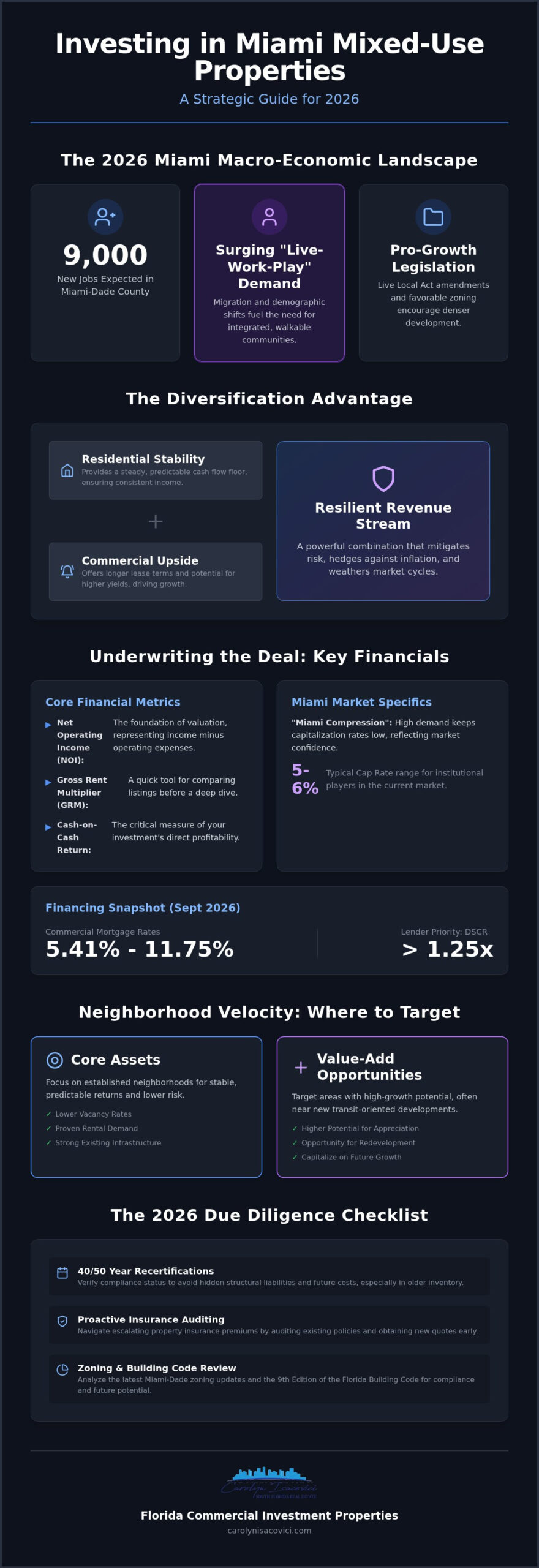
The local economy is thriving. With approximately 9,000 new jobs expected to be added in Miami-Dade County throughout 2026, the influx of professional talent is driving a massive need for integrated spaces. Corporate relocations aren’t just bringing employees; they’re bringing people who want to walk to work and grab coffee on the ground floor of their own building. Current Miami real estate market trends show a distinct favor toward high-density assets that maximize land utility.
Demographic shifts are equally compelling. We’re seeing a rise in “urban explorers” across all age groups who prioritize walkability over long commutes. This shift is supported by recent legislative changes, such as the 2026 amendments to the Live Local Act, which encourage denser development. It’s a strategic moment for those looking to capitalize on a 0.7% employment increase and a growing preference for vibrant, urban environments.
Diversification: The Mixed-Use Advantage
How do you protect your portfolio against a shifting economy? Diversification is the key. By combining residential units with commercial leases, you significantly mitigate the risk of total vacancy. While residential rents provide a steady, predictable floor, commercial leases often offer longer terms and the potential for higher Florida commercial real estate for sale yields. This balance is at the heart of the commercial vs residential investment Florida debate.
Mixed-use assets allow you to capture the best of both worlds, offering a recession-resistant buffer that pure-play assets often lack. When the commercial retail sector faces a shift, your residential occupancy keeps the lights on. Conversely, when residential turnover occurs, your long-term commercial tenants provide the stability you need. It’s a thoughtful approach to investment that prioritizes both growth and security.
Underwriting the Deal: Financial Frameworks for Miami Analysis
How do you place a precise value on a property that wears two hats? When evaluating a Miami mixed-use property for sale, your analysis begins with Net Operating Income (NOI). This figure represents your total income minus operating expenses, excluding debt service. In 2026, we are seeing a unique phenomenon known as “Miami Compression.” This occurs when high investor demand keeps capitalization rates lower than national averages, reflecting the market’s perceived stability and growth potential. While institutional players might look at a 5% or 6% cap rate, you must ensure your specific deal supports your personal yield requirements.
Gross Rent Multiplier (GRM) serves as a helpful high-level screening tool. It’s a quick way to compare local listings before diving into a deep-dive audit. However, your Cash-on-Cash return is what truly tells the story of your pocketbook. With commercial mortgage rates in September 2026 ranging from 5.41% to 11.75%, your financing strategy is just as important as the purchase price. Most lenders currently prioritize a Debt-Service Coverage Ratio (DSCR) of at least 1.25x, meaning your property must generate 25% more income than the annual debt payment to qualify for traditional financing.
Calculating the Commercial-Residential Split
Valuing a hybrid asset requires a dual-lens approach. You’ll often apply a lower cap rate to the stable residential portion and a slightly higher, risk-adjusted rate to the commercial storefronts. A blended cap rate is the weighted average of the individual capitalization rates applied to the commercial and residential income streams based on their respective contributions to the total property value. Lease durations also play a pivotal role; a five-year commercial lease with a credit tenant provides a different level of security than a month-to-month residential agreement.
Adjusting for the Florida Factor in 2026
Successful underwriting requires a realistic look at “soft costs” that are unique to the Sunshine State. When modeling your pro forma for investment property Florida, you must account for the property tax reset. In Miami-Dade County, the average tax rate is approximately 1.94% of the assessed fair market value, and this figure typically jumps significantly after a title transfer. Insurance premiums also require a conservative buffer. We recommend allocating higher maintenance reserves to account for the relentless humidity and salt air, ensuring your asset remains in peak condition. If these numbers feel complex, it may be time to consult with a local expert who can help refine your model.
Neighborhood Velocity: Where to Target Mixed-Use Acquisitions
How do you choose the right location when every corner of Miami seems to be buzzing? It’s about understanding “velocity,” which is the speed and direction of a neighborhood’s economic growth. When you’re browsing for a Miami mixed-use property for sale, you must distinguish between Core markets that offer stable, predictable yields and Value-Add markets that offer significant appreciation potential. Location isn’t just a static address; it’s a dynamic factor that dictates your tenant quality and long-term exit strategy.
Transit-oriented development (TOD) is a primary driver for mixed-use success in 2026. Properties located near Brightline stations or Metrorail hubs are seeing a distinct “transit premium” in their valuations. Why? Because connectivity is the ultimate amenity. This is closely tied to a property’s Walkability Score. In modern Miami, a high walkability rating isn’t just a perk; it’s a measurable metric that directly correlates with higher rent premiums for both retail storefronts and residential apartments. Beyond the city center, we’re seeing high-velocity hubs emerging from Hollywood FL up through the Treasure Coast, where savvy investors are finding more accessible entry points with strong demographic tailwinds.
The Core Markets: Brickell and Edgewater
Brickell remains the undisputed “Wall Street of the South.” It’s a low-vacancy environment where demand for luxury residential units perfectly complements the high-end retail and office spaces below. While entry prices are undeniably higher here, the institutional-grade stability is a powerful draw for those prioritizing wealth preservation. By analyzing Miami property appreciation investment data, it’s clear that these core areas provide a reliable floor for your capital. The risk isn’t in the demand; it’s in the competition for limited inventory.
The Growth Frontier: Little Havana and North Miami
Are you looking for higher upside? Little Havana and North Miami have become favorites for strategic Florida real estate portfolio building. These neighborhoods are currently navigating the gentrification curve, offering a “sweet spot” for investors who can spot under-managed assets. We often see older mixed-use buildings in these areas that are ripe for modernization. By improving the management and aesthetics of these properties, you can capture the rising tide of these high-velocity neighborhoods before they reach their peak pricing. It’s about timing your entry to match the neighborhood’s evolution.
The 2026 Due Diligence Checklist for Mixed-Use Assets
What is the true cost of a missed detail during the inspection period? It’s often measured in thousands of dollars of unforeseen repairs or legal hurdles. Precision matters. When you’re evaluating a Miami mixed-use property for sale, your due diligence process must be more than a cursory glance; it needs to be a deep-dive technical audit. We focus on four critical pillars to ensure your transition from prospect to owner is seamless and secure.
- The 40/50 Year Recertification: For older stock in Miami-Dade, this is non-negotiable. You must verify that the building has passed its structural and electrical inspections, as these requirements have become significantly more stringent following recent legislative updates.
- Insurance Auditing: Don’t wait. Secure binding quotes before your inspection period ends. With premiums fluctuating, knowing your exact carrying costs is vital for your final pro forma.
- Zoning and Land Use: Verify the legality of the current mixed-use split. You want to ensure that the residential-to-commercial ratio complies with municipal codes to avoid future enforcement actions.
- Estoppel Certificates: These are your best friend. They confirm the commercial tenant terms, security deposits, and any “handshake deals” the previous owner might have made, protecting you from post-closing surprises.
Structural Integrity and Climate Resilience
In the 2026 Miami market, structural integrity isn’t just a safety metric; it’s the absolute foundation of your asset’s long-term equity. You’ll need to scrutinize elevation certificates and perform a detailed flood zone analysis. The 9th Edition of the Florida Building Code, taking effect at the end of 2026, emphasizes wind resistance and water intrusion protection. Evaluating the cost of future climate-related retrofitting now prevents your capital from being trapped in a building that requires massive, unplanned upgrades later.
Legal and Regulatory Compliance
Success requires a clear understanding of the shifting legal landscape. You must navigate Miami’s specific short-term rental (STR) ordinances, which can vary significantly between mixed-use buildings and traditional residential blocks. Furthermore, the 2026 amendments to the Live Local Act have changed the game for density and development potential, often preempting local height restrictions for qualifying projects. Ensuring all investment property due diligence Florida steps are met allows you to buy with a steady hand. If you want to ensure your checklist is bulletproof, you can schedule a due diligence consultation with our team to review the specifics of your potential acquisition.
Executing Your Miami Mixed-Use Acquisition Strategy
How do you move from detailed analysis to successful ownership? It’s one thing to identify a Miami mixed-use property for sale; it’s another to navigate the closing process on favorable terms. A specialized broker acts as your strategic engine, translating raw data into a compelling offer that sellers take seriously. In a market where the best assets often move before they hit public portals, local relationships are your greatest currency. We leverage deep-rooted connections to surface off-market opportunities, giving you a head start in a competitive environment.
Success isn’t a solo sport. You need a 2026 acquisition team that includes specialized lenders, forensic inspectors, and attorneys who understand the nuances of mixed-use contracts. Your broker orchestrates this ensemble, ensuring every piece of the puzzle fits perfectly. When the inspection reveals necessary upgrades, your broker steps in to negotiate repair credits, protecting your capital and ensuring the deal remains financially viable. This level of advocacy ensures that you aren’t just buying a building; you’re securing a sound investment.
Why a Local Broker is Your Competitive Advantage
Can an algorithm truly value a hybrid asset? While automated tools like a “Zestimate” provide a generic starting point, they often fail to account for the specific commercial-residential split we discussed earlier. A Broker’s Opinion of Value (BOV) provides a more nuanced, street-level reality. Carolyn Isacovici uses her 20 years of market cycle experience to identify “red flag” listings that others might miss. This seasoned insight is crucial when you’re looking to transition from a single asset to a diversified Florida real estate portfolio. We focus on finding the value that isn’t always visible on a spreadsheet.
Next Steps for the Serious Investor
Are you ready to take the next step? The most successful investors in 2026 are those who arrive prepared. This means having your proof of funds ready and your specific investment criteria clearly defined. Whether you’re targeting a stable yield in Brickell or a value-add play in Little Havana, clarity is your best tool. We’re here to help you refine your target list and navigate the complexities of the Miami market with a steady hand. If you’re ready to move forward, we invite you to schedule your 2026 Miami investment strategy session today. Let’s turn your investment goals into a tangible reality.
Securing Your Future in the Miami Market
The path to a successful investment in 2026 is paved with both data and local wisdom. We’ve explored how balancing residential stability with commercial upside creates a resilient portfolio, especially when you align your targets with high-velocity neighborhoods like Little Havana or the established corridors of Brickell. Success requires more than just finding a Miami mixed-use property for sale; it demands a rigorous approach to due diligence that accounts for the latest Miami-Dade zoning shifts and structural recertification requirements.
With over 20 years of experience navigating these complex market cycles, we specialize in high-yield investment brokerage that prioritizes your long-term success. We understand the nuances of the 2026 regulatory landscape and the technical depth required for hybrid assets. Why navigate these complexities alone when you can have a seasoned guide by your side? You can contact Carolyn Isacovici for a custom Miami mixed-use analysis to refine your strategy. Let’s work together to transform today’s market conditions into your next great opportunity. Your vision for a high-performing South Florida portfolio is well within reach.
Frequently Asked Questions
What is a good Cap Rate for a Miami mixed-use property in 2026?
A competitive cap rate for a Miami mixed-use property for sale in 2026 typically ranges between 5% and 6.5% for core assets. While national averages might be higher, Miami’s market compression reflects the high demand and limited inventory in South Florida. Investors should prioritize the debt-service coverage ratio (DSCR) over the cap rate alone. Most lenders currently require a DSCR of at least 1.25x to approve financing in this interest rate environment.
How do Florida insurance increases affect mixed-use investment analysis?
Rising insurance premiums are a critical factor in your pro forma analysis. They directly reduce your Net Operating Income (NOI), which can lower the overall valuation of the asset. We recommend securing binding quotes during your inspection period rather than relying on the seller’s historical costs. Factoring in these escalating soft costs ensures your investment remains profitable even as the 9th Edition of the Florida Building Code introduces stricter resilience requirements for all buildings.
What is the 40-year recertification, and why does it matter for investors?
This is a mandatory safety inspection for buildings in Miami-Dade that have reached 40 years of age, followed by subsequent 10-year intervals. It ensures the structural and electrical systems are sound. For investors, this matters because failure to comply can lead to massive repair assessments or even building closure. Always verify that a property has a current certificate or a clear path to passing its upcoming inspection before you close the deal on any older asset.
Can I use a 1031 Exchange to buy mixed-use property in Miami?
Yes, you can absolutely use a 1031 Exchange to acquire mixed-use assets. This tax-deferred strategy allows you to sell a qualifying investment property and reinvest the proceeds into a like-kind asset, such as a Miami mixed-use property for sale. It’s an excellent way to defer capital gains taxes while upgrading your portfolio. We frequently work with investors to identify suitable replacement properties that meet strict federal timelines and specific high-yield investment goals for 2026.
Which Miami neighborhoods have the highest mixed-use growth potential?
Little Havana and North Miami currently show the highest velocity for mixed-use growth. These areas benefit from the 2026 amendments to the Live Local Act, which encourage higher density and affordable housing components. We are also seeing significant interest in Hollywood FL and the Miami River District. These neighborhoods offer a compelling gentrification curve, allowing investors to enter at a lower price point compared to the established core markets of Brickell or Edgewater in 2026.
Is mixed-use considered commercial or residential real estate in Florida?
Mixed-use property is generally classified as commercial real estate because it generates income from multiple sources. However, the specific underwriting often splits the asset into residential and commercial components. For tax purposes in Miami-Dade, the residential portion might qualify for certain exemptions if it serves as a primary residence, but the overall asset is valued based on its income-producing potential. It’s a hybrid class that requires a specialized brokerage approach to value correctly and accurately.
How does the Live Local Act impact existing mixed-use property owners?
The Live Local Act, specifically the 2026 amendments under House Bill 1389, provides significant advantages for density. It allows owners to bypass certain local zoning restrictions regarding building height and setbacks if they include a specific percentage of workforce housing. This can dramatically increase the development potential of an existing site. It’s a powerful tool for owners looking to expand their footprint or redevelop older stock in high-demand urban corridors throughout South Florida this year.
What are the typical closing costs for a mixed-use sale in Miami-Dade?
Typical closing costs for a mixed-use sale range from 1.5% to 3% of the purchase price for the buyer. This includes the Florida documentary stamp tax on the mortgage, which is $0.35 per $100 of the loan amount, and the intangible tax at 2 mills. You should also budget for title insurance, appraisal fees, and environmental surveys. We always provide our clients with a detailed closing cost estimate early in the process to prevent any surprises.
Leave a Reply