
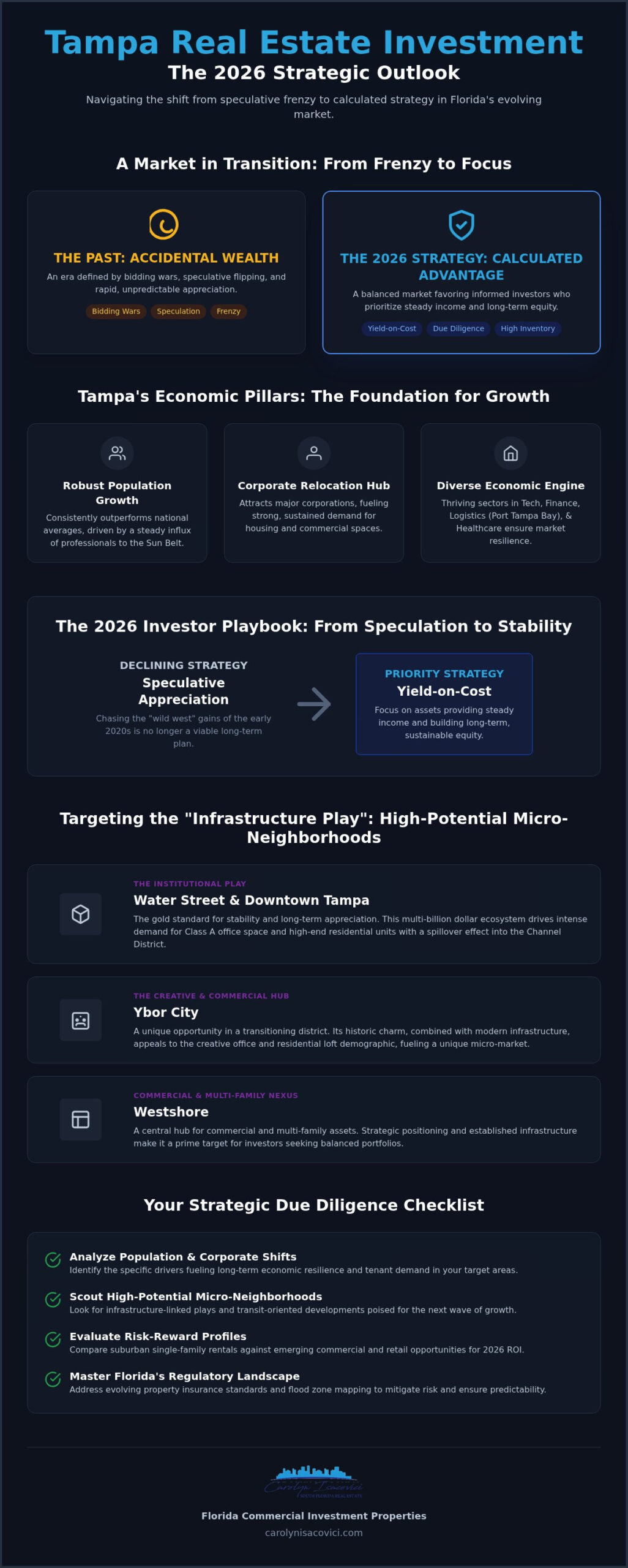
The era of accidental wealth in Florida real estate has transitioned into an era of the calculated strategist. You’ve likely noticed that the bidding war frenzy has cooled, replaced by a more balanced market where inventory is at a multi-year peak. It’s understandable to feel cautious as insurance costs average around $5,341 and new tax laws loom on the horizon. However, this stabilization is exactly what makes the current selection of Tampa investment properties for sale so compelling for those who know where to look.
You’re about to discover why Tampa remains a resilient cornerstone of the Sunshine State and how you can secure high-yield assets in this evolving landscape. We’ll provide a clear framework for evaluating 2026 ROI, analyze the critical shift from residential to commercial demand, and guide you through the micro-neighborhoods poised for the most significant infrastructure growth. By the end of this guide, you’ll have the insight needed to transform market uncertainty into a definitive strategic advantage. Let’s explore how to navigate this new cycle with confidence and precision.
Key Takeaways
- Identify the specific population shifts and corporate relocations that continue to fuel Tampa’s long-term economic resilience.
- Discover how to spot high-potential micro-neighborhoods and infrastructure-linked plays when evaluating Tampa investment properties for sale.
- Compare the 2026 risk-reward profiles of suburban single-family rentals against emerging commercial and retail opportunities.
- Develop a robust due diligence checklist that addresses Florida’s evolving property insurance standards and flood zone mapping.
- Learn why partnering with a seasoned local broker is essential for navigating complex regulations and securing high-value assets.
The Tampa Real Estate Market in 2026: Why Investors Stay Bullish
Why does the Tampa-St. Petersburg-Clearwater MSA continue to attract significant capital? It’s the people. By 2026, population growth in this region has consistently outperformed national averages, driven by a steady influx of professionals seeking the Florida Sun Belt’s lifestyle and economic advantages. This isn’t just a temporary surge; it’s a structural shift. For a comprehensive Tampa, Florida overview, one can see how the city’s historical evolution and geographic advantages support this modern expansion. As more corporations relocate their headquarters to the region, the demand for high-quality housing and commercial spaces remains robust.
Does the mention of insurance costs or climate resilience cause hesitation? It’s a valid question. However, the 2026 market has matured. Legislative reforms and enhanced building codes have created a more predictable environment for sophisticated investors. We view these factors not as roadblocks, but as necessary variables to be managed within a Strategic Florida Real Estate Portfolio Building plan. When you look at the available Tampa investment properties for sale through a lens of long-term stability, the opportunity becomes clear. The “calm expert” sees these market adjustments as a filter that clears out speculative noise, leaving high-value assets for those with a professional partner.
Economic Drivers and Job Market Expansion
Downtown Tampa has transformed into a vibrant hub for tech and finance, attracting a younger, high-earning demographic. This migration fuels the need for both residential and retail assets in the urban core. Meanwhile, the Port of Tampa Bay continues to be a massive engine for industrial property demand, serving as a gateway for international trade and logistics. When you combine this with the rock-solid stability of the healthcare and education sectors, you get an economy that doesn’t just survive cycles; it thrives through them. These diverse employment sectors ensure that tenant demand remains high across multiple asset classes.
The 2026 Forecast: Appreciation vs. Cash Flow
The “wild west” appreciation of the early 2020s has settled into a phase of sustainable, predictable growth. In 2026, successful investors prioritize “Yield-on-Cost,” looking for assets that provide steady income while building long-term equity. This shift away from speculative flipping toward disciplined acquisition is a sign of a healthy, adult market. It’s about finding the right Tampa investment properties for sale that align with your specific financial goals rather than chasing a trend. The 2026 Tampa market represents a balanced opportunity where investors can capture reliable cash flow today while positioning themselves for meaningful equity gains tomorrow.
Targeting the Best Neighborhoods for Tampa Investment Properties
How do you choose between a high-traffic urban core and a quiet suburban pocket? In 2026, the answer lies in following the “Infrastructure Play.” Smart investors are looking beyond current aesthetics to identify where Tampa’s economic development initiatives are concentrating capital. This strategy focuses on transit-oriented developments and mixed-use hubs that create their own demand. While some areas have reached saturation, emerging micro-markets offer a more attractive entry point for those seeking Tampa investment properties for sale. By moving toward areas with planned transit expansions, you position your portfolio to benefit from the next wave of appreciation.
Water Street and Downtown Tampa: The Institutional Play
The multi-billion dollar Water Street development has redefined the city’s skyline. It’s not just about new buildings; it’s about the creation of an entirely new ecosystem. This institutional-grade project has driven intense demand for high-end residential units and Class A office spaces. We’re seeing a significant spillover effect into the Channel District, where older industrial footprints are being reimagined as luxury dwellings. If you’re looking for stability and long-term appreciation, this urban core remains the gold standard for institutional plays. The demand for walkable, high-amenity living remains a primary driver for values in this district.
Ybor City and Westshore: Commercial and Multi-Family Hubs
Ybor City offers a different flavor of opportunity. Its transition into a creative office and residential loft destination is well underway. The historic charm, combined with modern infrastructure, appeals to a demographic that rejects the traditional corporate cubicle. It’s a unique micro-market where heritage meets high-tech demand. Conversely, Westshore remains the largest office submarket in Florida. Its proximity to the airport and major thoroughfares makes it a powerhouse for commercial demand. When evaluating the density here, many investors draw parallels to the multi-family property for sale Miami market, noticing how Westshore is evolving into a true live-work-play district. This concentration of employment makes Westshore a reliable target for multi-family acquisitions.
Identifying these nuances is where professional guidance becomes invaluable. If you’re ready to explore these specific micro-markets, it’s helpful to consult with a local broker who understands the block-by-block dynamics of the region. Finding the right Tampa investment properties for sale requires more than just looking at a map; it requires an understanding of where the city is headed over the next decade. Historic districts, once overlooked, are now becoming high-yield opportunities for those willing to navigate the preservation requirements in exchange for unique, high-demand assets.
Commercial vs. Residential: Choosing Your Tampa Asset Class
Which asset class offers the best protection against market shifts? In 2026, the choice between commercial and residential assets isn’t just about the numbers; it’s about your personal risk tolerance and management style. Retail and office spaces in Tampa have seen a revitalization as mixed-use developments become the norm. While these commercial assets often offer higher cap rates, they also require a deeper understanding of lease structures and tenant credit. Conversely, the single-family rental (SFR) market in suburban Tampa remains incredibly resilient, providing a steady floor for investors who prioritize consistent cash flow. For a deeper dive into these nuances, explore our Commercial vs Residential Investment Florida guide.
When you evaluate Tampa investment properties for sale, you’ll find that residential multi-family units currently offer a more accessible entry point for many, though cap rates may be slightly more compressed compared to specialized retail. The key is to match the asset to your portfolio’s specific needs. Are you looking for the hands-off nature of a NNN commercial lease, or do you prefer the high demand of the residential sector? Both paths lead to success when navigated with a clear strategy.
The Rise of Industrial and Flex Space
Have you considered the “last-mile” delivery boom? The I-4 corridor has become a primary artery for logistics, creating a surge in demand for industrial flex space. Small-bay industrial properties are particularly attractive in 2026 because they offer portfolio diversification without the heavy capital requirements of massive warehouses. Certain Tampa industrial zones also offer specific zoning advantages that allow for higher density or specialized usage. This niche remains a favorite for those looking to capture the growth of e-commerce and local service businesses.
Residential Investment: New Construction vs. Value-Add
Is it better to buy new or renovate? For many, the appeal of buying new construction homes in Florida lies in the lower maintenance costs and modern building standards that help mitigate insurance premiums. However, the value-add strategy is still thriving in established neighborhoods like Seminole Heights. Here, investors can find older homes with character and upgrade them to meet the demands of modern tenants. When looking at Tampa investment properties for sale, you must decide between the reliable, long-term rental model or the potentially higher-yielding short-term vacation stay. Each requires a different operational framework, but both benefit from Tampa’s consistent population growth.
Navigating Due Diligence for Tampa Acquisitions
Does the technical side of a Florida closing feel overwhelming? It doesn’t have to. While the state’s regulatory landscape is unique, approaching it with a methodical mindset transforms potential hurdles into manageable steps. Success in 2026 requires a deep understanding of how to evaluate investment property Florida metrics, particularly when assessing Tampa investment properties for sale. We prioritize clarity over confusion, ensuring you understand exactly how flood zone mapping and insurance premiums impact your bottom line. With the average annual cost of homeowners insurance in Tampa reaching approximately $5,341 as of August 2026, verifying elevation certificates and wind mitigation reports isn’t just a suggestion; it’s a financial necessity.
The local tax environment also requires a steady hand. While the “Save Our Homes” assessment cap provides significant relief for primary residents, investors must look toward the November 2026 ballot. A proposed constitutional amendment (HJR 1F) could potentially reduce the maximum annual assessment increase on non-homestead properties from 10% to 5%. Staying ahead of these legislative shifts allows you to project your long-term carrying costs with far greater accuracy. We help you navigate these details so you can focus on the growth potential of your portfolio.
The Financial Deep Dive: Beyond the Cap Rate
Calculating your Net Operating Income (NOI) requires realistic 2026 expense ratios that account for modern service costs and updated property tax millage rates. In this market, professional property management is your greatest ally in protecting ROI, as they handle the day-to-day complexities that out-of-state owners might miss. It’s also vital to remember that utilizing a 1031 Exchange is an essential strategy for deferring capital gains taxes and scaling your holdings effectively. By looking beyond the initial cap rate, you ensure the asset remains a high-performer throughout the entire holding period.
Local Regulations and Zoning Laws
Tampa maintains specific rules regarding short-term rentals, especially in residential neighborhoods where AirBnB activity is closely monitored. Understanding these local ordinances prevents costly compliance issues after you’ve already committed capital. For those exploring commercial land or industrial assets, environmental assessments are non-negotiable to uncover any historical site concerns. Working with a local expert is often the only way to uncover off-market opportunities that never reach public portals. If you are ready to move forward, you can secure your next acquisition by leveraging our deep network of local connections and regulatory insights.
Partnering for Success in the Florida Market
How do you move from analysis to acquisition? The final step in any successful investment journey is choosing the right professional partner. In a market as nuanced as Tampa’s, the difference between a standard transaction and a high-yield acquisition often comes down to the quality of the brokerage. Carolyn Isacovici specializes in transforming market uncertainty into clear opportunity, providing the steady hand needed to navigate 2026’s unique conditions. Whether you’re targeting residential portfolios or looking for a foothold in the commercial sector, having an expert who manages the end-to-end sales process ensures that no detail is overlooked. It’s also helpful to view these opportunities within the broader context of the state. For instance, comparing local shifts against Miami real estate market trends can provide a valuable benchmark for timing your entry into different Florida submarkets.
Securing the right Tampa investment properties for sale requires more than just a search engine; it requires a navigator who understands the block-by-block evolution of the city. We provide comprehensive support for both commercial and residential transactions, ensuring that your capital is placed in assets with the highest potential for resilience. By taking a long-term view of the Florida market, we help you build a portfolio that isn’t just surviving the current cycle but is positioned to lead the next one.
The Advantage of a Seasoned Florida Broker
Why settle for a purely transactional relationship? An advisory approach goes beyond simply showing you Tampa investment properties for sale; it involves deep-tier strategic planning and risk mitigation. Since 2006, our firm has maintained a focused presence in Florida’s most competitive markets, helping investors identify high-value holdings that others might miss. This longevity means we’ve seen various cycles and remain unruffled by temporary market fluctuations. We don’t just sell property; we help build legacies by focusing on high-yield investment property identification and navigating the complex regulations that define the Sunshine State.
Next Steps: Securing Your Tampa Asset
Ready to take the next step? The path forward begins with a clear, professional portfolio review or a targeted property search. In the 2026 market, timing is everything, but speed should never come at the expense of professional guidance. We provide the structural support required to move from the “what if” phase to a finalized closing with confidence. Tampa’s future is exceptionally bright for the informed investor who acts with precision. By aligning yourself with a partner who understands the local landscape, you ensure that your capital is positioned for maximum resilience and growth. Let’s transform your 2026 goals into a tangible, high-performing reality.
Capitalizing on the Tampa Advantage
Is your portfolio ready for the next decade of Florida growth? Success in 2026 belongs to those who look past the noise and focus on the structural strengths of the region. Modern infrastructure plays and a disciplined approach to due diligence help mitigate risks like rising insurance costs. Whether you’re exploring commercial flex space or residential multi-family units, the current selection of Tampa investment properties for sale offers a resilient foundation for long-term wealth. You don’t have to navigate these complexities alone.
Choosing the right assets requires a navigator who understands the block-by-block evolution of this city. Carolyn Isacovici has specialized in high-value Florida assets since 2006, providing a steady, advisory hand across both commercial and residential investment brokerage. We transform complex market conditions into clear, actionable strategies for our partners. Consult with Carolyn Isacovici to find your next Tampa investment property today. The future of the Sun Belt is bright, and with professional guidance, you can claim your place in its success with complete confidence.
Frequently Asked Questions
Is Tampa a good place for real estate investment in 2026?
Tampa remains a premier destination for capital in 2026 because of its robust job market and steady population influx. While the frantic bidding wars of the past have subsided, they’ve been replaced by a healthy, balanced market with record inventory levels. This stability allows you to evaluate Tampa investment properties for sale with much greater precision. It’s an ideal environment for investors who prioritize long-term equity growth over short-term speculation.
What are the best neighborhoods in Tampa for rental properties?
Identifying the right neighborhood depends on your specific asset class. Water Street and the Channel District are the gold standards for high-end urban living and institutional-grade office space. If you’re seeking character and value-add potential, Seminole Heights and Ybor City offer unique residential and creative flex opportunities. Westshore remains a powerhouse for multi-family demand due to its status as a massive employment hub. Each area provides a distinct path to achieving your ROI goals.
How do Florida insurance costs affect Tampa investment ROI?
Insurance is a significant variable in any Florida pro forma, with average annual premiums in Tampa reaching $5,341 as of August 2026. These costs directly impact your net operating income, so they must be factored into your initial due diligence. We recommend looking at newer construction or properties with updated wind mitigation features to help stabilize these expenses. A calm, calculated approach to these carrying costs ensures your high-value holdings remain profitable over the long term.
Should I buy commercial or residential property in Tampa?
Both asset classes offer unique advantages in the 2026 landscape. Residential properties, particularly single-family rentals in suburban pockets, provide incredible resilience and consistent tenant demand. On the other hand, commercial assets like small-bay industrial or retail flex space can offer higher yields and more hands-off management through NNN leases. Your choice should align with your management capacity and your desire for either steady cash flow or significant long-term appreciation.
What is the average cap rate for Tampa investment properties?
Cap rates in Tampa have stabilized as the market moved away from the extreme compression seen in previous years. While residential multi-family units often see more competitive pricing, industrial and specialized retail assets typically offer slightly higher yields to account for their different risk profiles. It’s essential to look beyond the top-line percentage and evaluate the quality of the underlying asset and the strength of the local submarket’s infrastructure to ensure sustainable returns.
How does Tampa’s growth compare to Miami for investors?
Tampa and Miami both serve as critical pillars of a strategic Florida real estate portfolio, but they offer different entry points. While Miami remains a global hub for institutional capital and luxury density, Tampa provides a high-growth alternative with a focus on domestic migration and corporate relocation. Many investors use Miami’s established trends as a benchmark to identify emerging opportunities in Tampa’s high-value micro-neighborhoods before they reach full market maturity.
What are the rules for short-term rentals in Tampa?
Short-term rental regulations in Tampa are governed by specific city ordinances that vary depending on the zoning of the property. It’s vital to verify local rules and any Homeowner Association restrictions before acquiring Tampa investment properties for sale intended for vacation use. As of July 1, 2026, new state rules also require HOAs to provide faster notice of violations, so staying compliant is more important than ever for maintaining a smooth and profitable operation.
Can I invest in Tampa new construction for high yields?
Investing in new construction is a sophisticated play for those looking to minimize maintenance and insurance hurdles. These properties often attract high-quality tenants and benefit from the latest building codes, which can lead to better financing terms and lower operating costs. While the initial entry price might be higher, the reduced capital expenditure over the first decade often results in a very attractive yield-on-cost for the patient, strategic investor who values asset longevity.
Leave a Reply