
What if an attractive cap rate is hiding expenses that could change your decision? Miami multi-family cap rates are a useful first signal, but they’re only as reliable as the income and operating costs behind them. When listings use different assumptions for vacancy, insurance, taxes, or repairs, comparing headline percentages can leave you with more questions than answers.
That uncertainty is understandable. A higher cap rate doesn’t automatically mean a better investment, and a market-wide benchmark may say little about a specific neighborhood, building, or property condition. A clearer approach is to calculate each property consistently, then interpret the result in its local context.
In this guide, you’ll learn how to verify net operating income, compare relevant Miami benchmarks, and assess how expenses, vacancy, property class, and submarket conditions may affect your analysis. You’ll also find practical due-diligence questions to consider before moving an acquisition forward. With a disciplined framework, cap rates become a useful tool for evaluating opportunities, not a number that makes the decision for you.
Key Takeaways
- Understand what a cap rate measures and why the quality of the underlying net operating income matters.
- See how Miami-specific factors, including taxes, insurance, maintenance, vacancy, and building condition, can shape a property’s numbers.
- Compare Miami multi-family cap rates using consistent, property-level evidence rather than relying on a headline figure.
- Use a practical underwriting sequence to separate verified financials from estimates and seller-provided claims.
- Connect careful analysis to a more informed property search and acquisition decision.
What Does a Miami Multi-Family Cap Rate Tell You About a Property?
A cap rate compares a property’s income with its value. For investors considering Miami multi-family cap rates, it can help screen opportunities and identify which ones merit closer review. But it’s a starting point, not a verdict: the result depends on how income, expenses, and property value are measured.
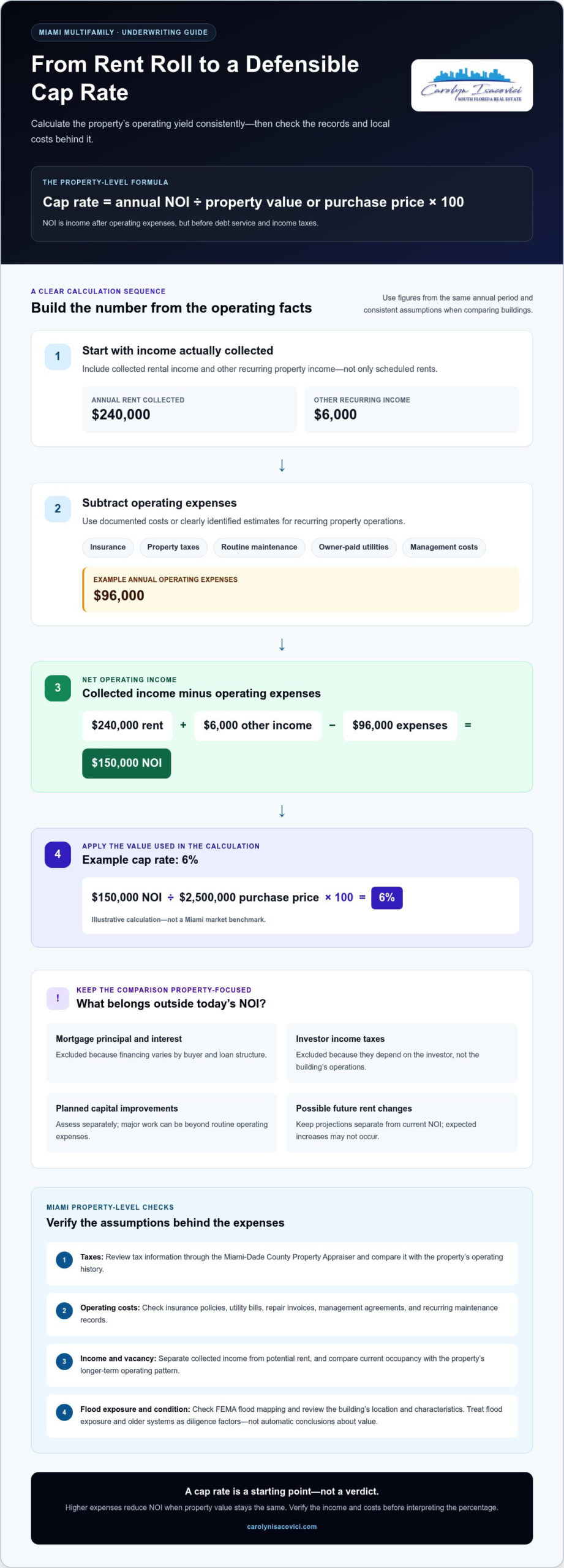
Cap rate = annual net operating income (NOI) ÷ property value or purchase price × 100; annual NOI is the property’s income after operating expenses but before debt service and income taxes, and property value or purchase price is the value used as the denominator. This is the standard property-level calculation described in Capitalization rate (cap rate) references.
How Do You Calculate a Multi-Family Cap Rate?
Start with income the property actually collects, rather than relying only on scheduled rents. Include collected rental income and other recurring property income, then subtract operating expenses such as insurance, property taxes, routine maintenance, owner-paid utilities, and management costs. Use figures from the same annual period and apply consistent assumptions when comparing buildings.
Illustrative example, not a Miami market benchmark: A multi-family property collects $240,000 in annual rent and $6,000 in other recurring income. If its annual operating expenses are $96,000, its NOI is $150,000. At a purchase price of $2,500,000, the cap rate is $150,000 ÷ $2,500,000 × 100, or 6%.
Keep the calculation property-focused. Mortgage principal and interest are excluded because financing varies by buyer and loan structure. Including them would mix the property’s operating performance with an individual investor’s financing. The same principle applies to income taxes, which depend on the investor rather than the building’s operations.
What Does a Cap Rate Leave Out?
A cap rate estimates an unlevered, property-level yield based on current NOI and the value used in the calculation. It doesn’t show the investor’s cash flow after loan payments or capture their full return after financing, taxes, and other investment-specific costs. Those outcomes require separate analysis and can differ substantially between buyers evaluating the same property.
It also doesn’t forecast future performance. Planned capital improvements, possible rent changes, and assumptions about resale value should be assessed separately rather than quietly built into today’s NOI. A building that needs major work may have expenses beyond routine operations, while projected rent increases may not materialize as expected.
So, does a higher cap rate automatically signal a better deal? No. It may reflect stronger income relative to price, or it may come with greater operating uncertainty, deferred maintenance, or other property-specific risks. Use the rate to frame questions, then test the income and expenses behind it before drawing a conclusion.
How Miami’s Local Conditions Shape Multi-Family Cap Rates
A metro-wide cap-rate figure can provide orientation, but it can’t tell you whether a particular building’s income will cover its operating costs. In Miami, property taxes, insurance, repairs, utilities, and vacancy assumptions all affect net operating income (NOI). Local underwriting starts with the specific asset, not just a market headline.
Local operating expenses can change a property’s calculated cap rate because higher expenses reduce NOI, lowering the percentage yield when the property value or purchase price stays the same. The reverse is also true: an optimistic expense estimate can make a property appear more attractive than its documented operating history supports.
Which Miami Operating Expenses Can Change NOI?
Build the expense picture from records and defensible assumptions. Review the property’s tax information through the Miami-Dade County Property Appraiser and compare it with the taxes reflected in the property’s operating history. Then examine insurance, owner-paid utilities, repairs, management, and recurring maintenance using invoices, policies, contracts, or clearly identified estimates. A seller’s summary is not a substitute for the underlying documentation.
Vacancy assumptions matter, too. A building’s current occupancy and rent collection may differ from its longer-term operating pattern, so distinguish collected income from potential rent. Flood exposure also calls for property-level review: check FEMA flood mapping and consider the building’s location and characteristics rather than assuming every property in a neighborhood faces identical conditions. Flood exposure or older building systems are diligence factors, not automatic conclusions about value.
Why Do Miami Benchmarks Vary by Property and Neighborhood?
Comparisons are more useful when properties share meaningful characteristics. Consider asset type, location, occupancy, building condition, and reporting period together. A renovated, stabilized property and a building with deferred repairs may show similar cap rates while presenting different operating needs and levels of uncertainty. The number alone doesn’t make them equivalent.
Separate evidence types, too. A completed transaction reflects a sale; a listing price is an asking figure, and a seller’s projected income is a claim until supported by records. Dated market commentary can offer context, but it shouldn’t replace comparable, current property-level evidence. Broader research from Florida International University (FIU) may help frame regional economic conditions, while the Miami real estate market trends guide adds local context. Use both as background, not as a substitute for verifying a specific building’s operations.
For Miami multi-family cap rates, keep each assumption visible: what’s documented, what’s estimated, and what still needs investigation. This makes comparisons clearer and helps you focus on the questions that could change your view of an opportunity. Investment-property acquisition guidance can connect your analysis with a focused property search.
How to Compare Miami Multi-Family Cap Rates Without Misreading Them
A cap-rate comparison is only as useful as the properties and figures behind it. Miami multi-family cap rates can look directly comparable while relying on different income periods, expense assumptions, or property conditions. Build a like-for-like view first, then use the percentage to identify differences worth investigating rather than to declare a winner.
What Makes Two Multi-Family Properties Comparable?
Start with properties that align in meaningful ways: property type, location, unit mix, occupancy, building condition, and measurement period. Normalize unusual one-time income or expenses so recurring operations are easier to compare. For every figure, record its source and date, and flag information that is missing or reported only by the owner.
A simple comparison worksheet can make gaps visible:
Property A | Verified price: record the source and date. Normalized NOI: note included adjustments. Occupancy: record the period measured. Condition: summarize documented repairs or upgrades.
Property B | Use the same fields and definitions as Property A. Mark figures that are estimates, owner-reported, or not yet supported by records.
If one property’s NOI includes a one-time insurance recovery or unusual repair expense while the other’s reflects routine operations, the raw rates may mislead. Make adjustments consistently and preserve the original figures so you can see what changed and why.
How Does Cap Rate Compare With Other Investment Metrics?
Cap rate provides a property-level view based on NOI and value, without factoring in a buyer’s loan structure. Cash-on-cash return, by contrast, compares annual pre-tax cash flow after debt service with the investor’s cash invested. Since financing terms and the amount of cash contributed vary, this metric is buyer-specific. It shouldn’t be treated as another name for cap rate.
Gross rent multiplier (GRM) compares a property’s price with its gross rental income. It can offer a quick screening perspective, but it doesn’t account for operating expenses. Two buildings with similar gross income can have very different NOI if taxes, insurance, maintenance, or vacancy differ. Use GRM as a rough comparison tool, not a substitute for expense analysis.
Consider two properties with the same calculated cap rate. One may have stable occupancy and well-documented operating costs; the other may have uncertain collections or substantial repairs ahead. The percentage is equal, but the diligence questions and potential operating risks are not. No single rate is universally good, bad, or typical for every Miami property.
For a broader framework that places these measures alongside other investment considerations, the Florida investment property evaluation guide can help put the comparison in context. Keep the source, date, assumptions, and property details attached to each metric. That discipline makes it easier to interpret differences and decide which opportunities deserve a closer look.
How to Underwrite a Miami Multi-Family Cap Rate Before Making an Offer
Before relying on a cap-rate result, establish what the property actually earns and spends. A disciplined review helps distinguish operating history from projections, spot gaps before they shape your offer, and show how sensitive the analysis is to uncertain inputs. Record each figure’s source, reporting period, and confidence level.
- Verify the rent roll. Match listed units, rents, lease terms, and occupancy against available leases and supporting records. Note vacancies, concessions, and rent figures that are projected rather than currently collected.
- Test collections. Compare reported rental income with operating statements and payment records for the periods available. Investigate gaps between scheduled rent and actual collections instead of assuming every occupied unit pays consistently.
- Normalize expenses. Review recurring costs and flag one-time items, unusual repairs, or expenses that may not reflect ongoing operations. Keep documented amounts separate from estimates and seller-provided claims.
- Calculate NOI. Use income and expense figures from a consistent reporting period, with adjustments clearly described. The calculated rate is only as reliable as its inputs and the period they represent.
- Compare evidence. Assess the result against relevant property and transaction evidence, noting differences in location, condition, occupancy, and the date of each source.
Which Documents Help Verify a Property’s NOI?
Useful records may include rent rolls, leases, operating statements, tax records, utility bills, insurance information, and maintenance history. Reconcile reported rents and occupancy with supporting documents where available. Look for deferred maintenance as well as irregular expenses that could distort a single reporting period. Record what each document supports, and label figures that remain unverified rather than treating them as established facts.
How Can You Test Whether the Investment Still Works?
Build sensitivity scenarios around vacancy, insurance, repairs, taxes, and other recurring costs. Adjust one assumption at a time, then consider how several less favorable changes together would affect NOI and the cap-rate calculation. Use documented history to inform the scenarios and label estimates as estimates. The purpose is to understand exposure, not to predict a precise future outcome.
Analyze financing separately. Compare the property-level cap rate with loan payments and investor-specific return measures, since financing assumptions can change an individual buyer’s cash flow without changing the property’s operating performance. For broader acquisition context, the Florida commercial real estate investor guide can help connect property analysis with the wider decision process.
Clear underwriting turns uncertainty into a list of specific questions and assumptions to evaluate. Investment-property acquisition guidance can connect your analysis with a Miami investment-property search.
Turn Miami Multi-Family Cap-Rate Analysis Into a Confident Next Step
A cap-rate calculation is most useful when it leads to a clearer decision, not when it’s treated as the decision itself. Establish reliable net operating income (NOI), compare properties using consistent evidence, assess local and building-specific risks, then decide whether the opportunity fits your goals. This sequence makes Miami multi-family cap rates a practical screening tool while keeping the final judgment grounded in the property and your investment plan.
Before advancing an opportunity, bring the key points of your analysis together:
- Confirm the income picture. Separate supported operating figures from projections and unresolved questions.
- Make a fair comparison. Use evidence for properties with relevant similarities, and note differences that could affect performance.
- Assess the risks. Identify expense, occupancy, condition, and other property-specific assumptions that deserve further attention.
- Decide on fit. Consider whether the opportunity aligns with your objectives and intended operating approach, not just its calculated rate.
That last step is personal. A property may deserve further review without being the right fit for your criteria, timeline, or investment strategy. An unresolved expense assumption doesn’t automatically rule out an opportunity, but it should remain visible as you weigh the next move.
What Should Investors Have Ready for an Acquisition Discussion?
A focused conversation starts with clear criteria and an honest picture of what you know so far. Define the property type you’re seeking, preferred locations, investment timeline, and intended operating approach. Bring available rent rolls, operating figures, and your initial cap-rate calculation, along with the period and assumptions used.
- List which figures are supported by records and which are estimates or seller-provided claims.
- Note missing details, unusual expenses, or building concerns that need further diligence.
- Identify the factors that matter most to your decision, such as location, occupancy, or condition.
This preparation keeps the discussion specific. It also gives you a useful way to compare new opportunities against the same priorities rather than resetting your criteria with every listing.
How Can Brokerage Guidance Support the Property Search?
Florida Commercial Investment Properties provides brokerage guidance for commercial and investment-property opportunities across Florida, including Miami. The firm manages the sales process and helps organize property review and transaction decisions around the information available, so you can assess how an opportunity aligns with your goals and where further diligence is needed. Brokerage guidance doesn’t replace your own investment judgment; it gives the search and acquisition process a clearer structure.
The firm’s Florida market includes Miami, Miami Beach, Hollywood, Fort Lauderdale, Palm Beach, Palm Beach Gardens, Stuart, Jupiter, Palm City, Port St. Lucie, Fort Pierce, Vero Beach, and Melbourne. Discuss your Florida investment-property goals and explore brokerage guidance for your acquisition search.
Make Your Next Property Decision With Clarity
The next opportunity doesn’t need to fit a headline benchmark. It needs to fit your investment objectives, operating plan, and comfort with the evidence available. Treat Miami multi-family cap rates as one part of the decision, and give yourself room to refine your criteria as you learn more about each property.
Whether you’re defining a search or weighing a specific acquisition, a focused discussion can help turn your priorities into a practical path forward. Florida Commercial Investment Properties supports commercial and investment-property transactions across Florida, with guidance led by Carolyn Isacovici, a Florida real-estate professional.
Bring your preferred property type, target locations, timeline, and the questions you’re still working through. Discuss your Florida investment-property goals to take the next step toward a well-considered opportunity. A clear plan can make the search more manageable and help you move forward with confidence when the right fit emerges.
Frequently Asked Questions
Is a higher cap rate always better for a Miami multi-family property?
No. A higher rate may mean stronger income relative to price, but it can also reflect issues that warrant closer review, such as uncertain rent collections, major upcoming repairs, or a less desirable location. Compare the reason for the rate, not just the rate itself. With Miami multi-family cap rates, a lower figure on a well-maintained property may fit an investor’s goals better than a higher figure with unresolved operating concerns.
Can a Miami multi-family property have a negative cap rate?
Yes. If a property’s operating expenses exceed its effective income for the period analyzed, its NOI is negative and its cap rate will also be negative when divided by a positive property value. This can happen during unusually high vacancies, costly repairs, or weak collections. Check whether the result reflects a temporary disruption or an ongoing operating problem, and verify that income and expense figures cover the same period.
How does a multi-family cap rate differ from cash-on-cash return?
A cap rate evaluates property income relative to the property’s value, while cash-on-cash return measures annual pre-tax cash flow against the investor’s cash invested. For example, two buyers could purchase the same building but use different loan amounts or financing terms, producing different cash-on-cash returns even though the property’s cap rate is unchanged. Compare these measures for their distinct purposes rather than substituting one for the other.
What is the difference between a going-in cap rate and an exit cap rate?
A going-in cap rate uses the property’s current or near-term NOI and the acquisition price to describe its yield at purchase. An exit cap rate is an assumption used to estimate the property’s value at a future sale, often by applying that rate to projected NOI at that time. Since the exit rate is a forecast input, test alternative assumptions instead of treating one resale estimate as certain.
Can interest-rate changes affect Miami multi-family cap rates?
Yes, indirectly. Interest-rate changes can affect borrowing costs and what buyers are willing or able to pay, which may influence sale prices and market cap rates. They don’t automatically change a property’s calculated rate if its NOI and value remain the same. For an acquisition analysis, update financing assumptions separately and consider whether changed buyer demand or pricing evidence calls for revisiting the property-value estimate.
Are Miami multi-family cap rates different from those in other Florida markets?
They can be, because locations differ in rents, operating costs, buyer demand, property mix, and transaction activity. Even within South Florida, a Miami building shouldn’t be compared with a Broward property without considering differences in neighborhood, asset type, occupancy, and condition. Use dated evidence for similar properties in the relevant market, and treat statewide or regional figures as context rather than a direct valuation for a specific building.
How often should an investor update a property’s cap-rate analysis?
Update it whenever new information could materially change income, expenses, or the value assumption, especially during acquisition review. For an owned property, regularly reviewing actual operating results against the underwriting can reveal changes in collections, vacancy, insurance, taxes, or repairs. Revisit the analysis after a major renovation, a change in occupancy, or a meaningful shift in operating costs, and keep each version’s date and assumptions clear.
Leave a Reply