Is a 4% yield in Brickell actually more profitable than a 7% return in Hialeah? When evaluating a cap rate Miami investment property in 2026, the numbers on the surface rarely tell the whole story. You might feel a sense of hesitation as rent growth stabilizes or worry that the county’s 2% property tax rate will erode your margins. It’s a common concern. Many seasoned investors are currently looking at the same spreadsheets and wondering if the “Miami premium” still makes sense in a shifting market.
I’m here to tell you that it does, provided you have the right map. This analysis will help you master the nuances of Florida capitalization rates, from the impact of the Live Local Act to the reality of $10,000 insurance premiums. We’ll move beyond basic math to build a reliable formula for Net Operating Income that accounts for every local variable. By the time you finish reading, you’ll have the benchmarks and the clarity needed to identify high-yield opportunities while avoiding the common pitfalls that stall most acquisitions.
Key Takeaways
- Establish clear 2026 benchmarks for various asset classes to ensure your expectations align with current market realities.
- Calculate your true Net Operating Income using a local formula that accounts for Miami’s unique 1.7% to 2% property tax reassessments.
- Learn why a lower cap rate Miami investment property in a high-demand area often provides better long-term liquidity than high-yield rural assets.
- Navigate the complexities of the 2026 market with confidence by understanding how new legislation like the Live Local Act impacts your potential returns.
- Gain a strategic advantage by leveraging professional brokerage to uncover off-market opportunities and protect your yield during the due diligence phase.
What is Cap Rate and Why Does it Matter for Miami Real Estate?
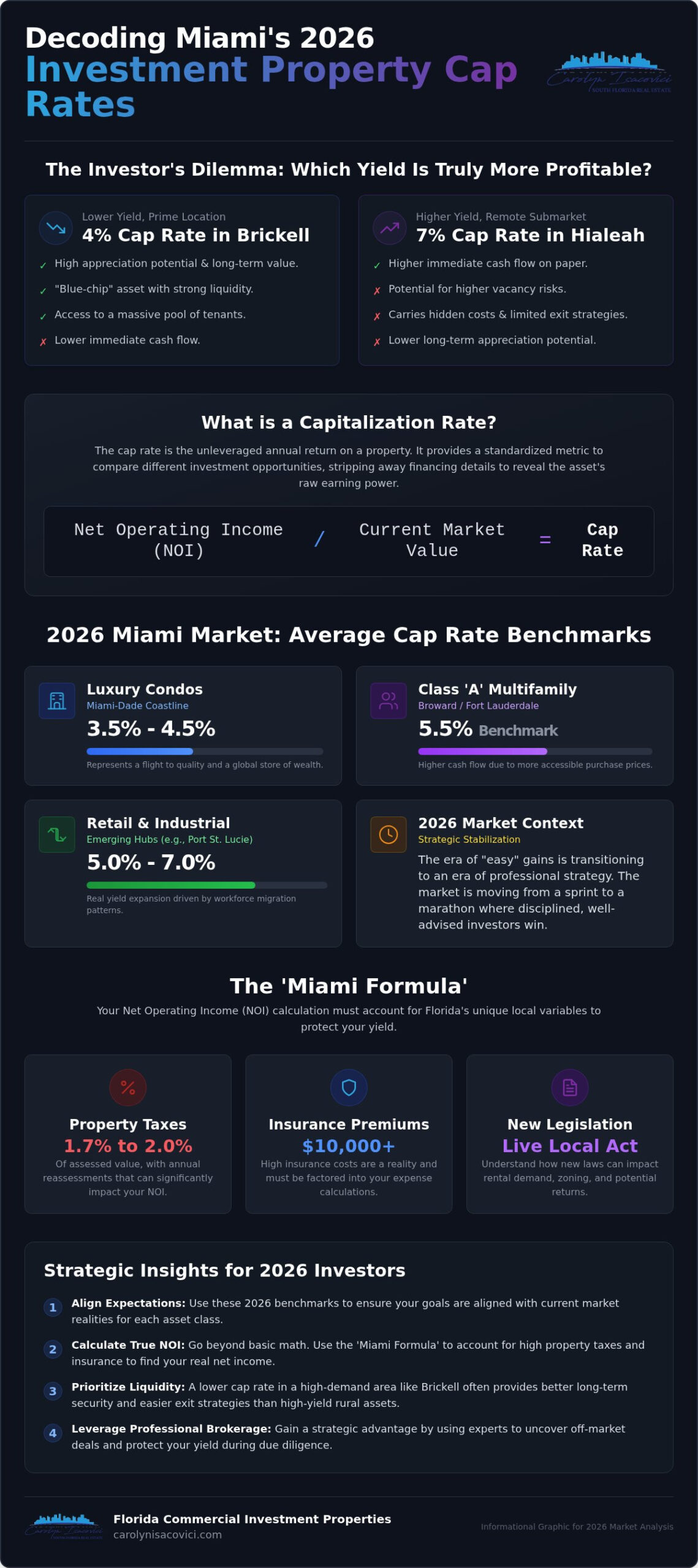
Pure math. That is the essence of a capitalization rate. At its core, the Capitalization rate, or cap rate, is the ratio of a property’s Net Operating Income (NOI) to its current market value or purchase price. It provides a snapshot of the unleveraged return an investor can expect in a single year. Why does this matter so much for a cap rate Miami investment property? In a market as dynamic as South Florida, having a standardized metric is the only way to compare a sleek condo in Edgewater to a sprawling warehouse in Doral without getting lost in the noise.
Miami is unique. Unlike many Midwestern markets where investors chase double-digit yields, Miami often commands lower “entry” cap rates. This isn’t a sign of weakness. Instead, it reflects the high appreciation potential and global demand that define our skyline. Investors are often willing to accept a 4% yield today because they recognize the long-term value of the land and the location. It’s about balancing immediate cash flow with the “liquidity moat” that prime Florida real estate provides.
Why would a seasoned guide recommend a 4% cap in Brickell over an 8% cap in a more remote submarket? It comes down to risk-adjusted returns. In the heart of Miami’s financial district, you are buying into a high-liquidity environment with a massive pool of potential tenants and a history of steady growth. The 8% yield elsewhere might look better on paper, but it often carries hidden costs, such as higher vacancy risks or limited exit strategies. For a cap rate Miami investment property, the lower percentage often signals a “blue-chip” asset that will hold its value through various market cycles.
Cap Rate vs. Cash-on-Cash Return
Does the cap rate tell you everything? Not quite. While the cap rate assumes you’ve paid all cash for valuation purposes, most investors use leverage. This is where cash-on-cash return enters the picture. In 2026, with interest rates finding a new equilibrium, your actual take-home yield depends heavily on your financing structure. Professional brokers rely on the cap rate as the primary “apples-to-apples” metric because it allows us to strip away the specifics of your bank loan and look at the raw earning power of the asset itself.
The 2026 Miami Market Context
The frenzy has cooled. After the massive rent surges seen in 2024 and 2025, we are seeing a necessary flattening of the curve. This doesn’t mean the opportunity has vanished. It simply means the era of “easy” gains is transitioning into an era of professional strategy. The 2026 cap rate environment is a period of strategic stabilization for Florida investors. Confidence remains robust because the underlying fundamentals, such as steady migration and a business-friendly climate, haven’t changed. We are moving from a sprint to a marathon, where the disciplined investor wins.
2026 Benchmarks: Average Cap Rates by Miami Asset Class
What does a “good” return look like in today’s market? It depends entirely on where you plant your flag. For many investors, a cap rate Miami investment property in the luxury condo sector represents a flight to quality rather than a hunt for high immediate yield. Currently, these assets hover between 3.5% and 4.5%. While those numbers might seem modest, they reflect the immense international demand and long term appreciation potential of the Miami-Dade coastline. These properties serve as a global store of wealth, offering a level of security that higher yielding assets in less stable markets simply cannot match.
This global perspective often extends to how investors manage their lifestyle; for those who frequent other top-tier destinations, you can learn more about GAAM Ibiza to access luxury villas and bespoke concierge services that mirror the high standards of Miami’s elite properties.
Are you seeking higher raw yields? You might look north. Broward and Fort Lauderdale frequently outperform Miami proper when it comes to monthly cash flow. In these submarkets, “Class A” multifamily assets have established 5.5% as the new reliable benchmark. This shift occurs because purchase prices in Broward often remain more accessible while rental demand stays white hot. Understanding these regional variances is essential, especially when considering how macroeconomic shifts influence Cap Rates, Explained by institutional leaders like JPMorgan Chase.
Residential vs. Commercial Yields
The landscape changes when you move into the commercial sector. For those interested in a multi-family property for sale Miami, the 5.5% target is a healthy goal for stabilized, high quality assets. However, the real yield expansion is happening in retail and industrial hubs. Emerging centers like Port Saint Lucie are seeing cap rates in the 5% to 7% range. These areas benefit from the “Live Local” migration patterns as workforce housing follows new infrastructure. Investors looking to benchmark these returns against the broader state should review the latest data on Florida commercial property investment returns across key asset classes and submarkets. For a broader view of these trends, see The Expert Guide to Florida Commercial Property Sales.
Neighborhood Spotlights: From Brickell to Jupiter
Location dictates your liquidity. Brickell remains the undisputed “liquidity moat” for high value real estate Miami, attracting consistent international capital that keeps cap rates compressed but exit strategies fast. If you are a yield seeking investor, growth sectors like Palm Beach Gardens and Stuart are becoming increasingly attractive. These neighborhoods offer a unique blend of suburban stability and rising commercial interest. In contrast, Hollywood, FL, provides a compelling middle ground, often delivering better yields than the ultra luxury markets of Miami Beach while still benefiting from coastal proximity.
Short term rentals (STR) present another fascinating 2026 dynamic. While gross yields can reach 6% to 9% in unrestricted markets, the high management overhead and 8% to 12% property management fees can quickly erode those gains. Additionally, investors must be wary of “yield compression” for new construction deliveries arriving in late 2026. Many of these units were purchased at 2024 price peaks, and rent growth is only now beginning to catch up. If you are navigating these timing risks, a strategic look at Investment Property Sales can help you identify which assets are truly positioned for growth.
The ‘Miami Formula’: Calculating Your Real Net Operating Income
How do you find the truth behind a listed percentage? While the Capitalization rate is a simple fraction, the variables within it require a local lens. Calculating the true yield for a cap rate Miami investment property starts with Gross Potential Income (GPI). In 2026, we’ve moved away from the double-digit rent spikes of the mid-2020s. Today, a realistic GPI assumes a stabilized vacancy rate of around 5% to 7% for multifamily units, reflecting a market that has finally caught up with supply. If your pro forma assumes 100% occupancy year-round, it’s time for a more grounded approach.
The most common mistake investors make is falling into the “Property Tax Trap.” You might see a seller’s current tax bill and assume those costs will carry over. They won’t. In Florida, the “Save Our Homes” cap and other exemptions often keep a long-term owner’s taxes artificially low. Upon sale, the property is reassessed based on the new purchase price. For your 2026 projections, you should budget between 1.7% and 2% of the purchase price for annual property taxes. This single adjustment can shift a 6% cap rate down to a 4.5% overnight if you aren’t prepared.
High-rise living brings its own set of mathematical requirements. Beyond basic maintenance, HOA fees in Miami’s luxury towers often cover significant amenities and staff, which cuts deeper into your NOI. You have to look past the surface level. To ensure your cash flow remains resilient, you must integrate Florida’s unique insurance premiums, often ranging from $3,500 to over $10,000 annually for landlord policies, directly into your line-item operating expenses to account for essential wind and flood coverage. Investors seeking to maximize returns despite these rising costs should explore the specific sectors and corridors identified as top performers in our analysis of high yield investment property Florida opportunities for 2026.
Accounting for the ‘Miami Extras’
Professional oversight isn’t just a luxury; it’s a safeguard for your yield. In the 2026 market, management fees for high-touch investment properties typically range from 10% to 15% of gross rent. This covers the rigorous tenant screening and compliance required in a post-Live Local Act environment. Additionally, if you are vetting older buildings, you must account for potential special assessments. With the 40/50-year recertification rules now strictly enforced across Miami-Dade, an aging building with “deferred maintenance” is often a liability in disguise.
The Critical Phase of Acquisition
Why is due diligence the most critical phase of your Florida acquisition? It’s the moment where you verify if the “Miami Formula” actually holds water. You don’t want to discover a massive assessment or a tax reassessment shock after you’ve already closed. Learn more about the full assessment process in our guide on How to Evaluate Investment Property in Florida. Taking a methodical, educational approach to these numbers transforms a stressful purchase into a confident strategic move.
Beyond the Number: When a Lower Cap Rate is a Smarter Buy
Is a higher number always better? Not necessarily. When you analyze a cap rate Miami investment property, it’s easy to get fixated on the immediate percentage. However, seasoned investors know that the cap rate is merely the starting line, not the finish. In the 2026 landscape, a lower cap rate often signals a “blue-chip” asset with a massive liquidity moat. Think of a 4% cap in Brickell as a high-grade bond. It’s easy to sell, attracts high-quality tenants, and sits on land that historically appreciates at a pace far outstripping rural or secondary markets. In contrast, an 8% cap in a remote area might look lucrative today, but it can quickly become a “marriage” to an asset that is difficult to exit when you need capital.
Risk mitigation is the silent partner in every successful acquisition. Prime locations protect you during market shifts by maintaining high occupancy when secondary markets falter. Furthermore, new construction homes and condos offer a distinct advantage in late 2026. While their entry yields might be compressed, these assets bypass the heavy maintenance costs and the strict 40/50-year recertification expenses currently hitting older Miami buildings. You’re trading a bit of immediate cash flow for a “cleaner” Net Operating Income and a much higher probability of significant equity growth over the next decade. Investors weighing these trade-offs across property types should consult the comprehensive benchmarks outlined in the 2026 strategic outlook for Florida commercial property investment returns to calibrate expectations by asset class.
The ‘Class’ Debate: A, B, or C?
The 2026 market is currently defined by a “Flight to Quality.” Class A assets offer low cap rates but unmatched stability in prime Miami corridors. For those with a higher risk appetite, Value-Add opportunities in Class B or C properties can still achieve 6.5% yields or higher. These require strategic renovation and a deep understanding of local tenant demands. Institutional investors are increasingly leaning toward Class A, prioritizing the preservation of capital and steady, predictable growth over the volatile hunt for double-digit returns in emerging submarkets.
Short-Term vs. Long-Term Strategy
Where should you park your capital for the most reliable return? Short-term rental (STR) yields often look impressive on paper, with gross returns reaching 9% in some pockets. However, once you strip away the 10% to 15% management fees and the volatility of a saturated market, the net result can be surprisingly thin. This is why many are pivoting back to long-term multifamily stability. Fort Lauderdale is currently ranked #1 for profitability in this sector, offering a perfect balance between consistent cash flow and long-term equity. If you’re ready to look beyond the spreadsheet and find an asset that fits your long-term goals, explore our current Investment Property Sales.
How a Miami Investment Broker Secures Your Yield
How do you bridge the gap between a spreadsheet and a successful closing? While understanding the math behind a cap rate Miami investment property is essential, the most lucrative opportunities often never reach the public market. A seasoned broker acts as your eyes and ears on the ground, uncovering off-market assets that offer superior yields before they are bid up by the general public. This insider access is particularly vital in 2026, where “strategic stabilization” means the best deals require deep local connections and a proactive approach to acquisition.
Expertise is more than just finding a property; it’s about protecting your Net Operating Income during the most vulnerable phase of the transaction. During due diligence, a professional guide verifies every expense, from the post-sale property tax reassessment to the specific wind mitigation credits on an insurance policy. We ensure that the 5.5% cap rate you were promised doesn’t evaporate due to overlooked special assessments or hidden maintenance liabilities. By managing the end-to-end sales process, we allow you to move from analysis to acquisition with total confidence.
The Carolyn Isacovici Advantage
Experience matters when navigating the complexities of the Florida market. With 20 years of market cycle experience, Carolyn Isacovici specializes in both residential and commercial investment property sales across Miami, Broward, and Palm Beach. Whether you are an institutional investor seeking high-value assets or an individual looking for new construction homes as a vehicle for wealth, we provide the steady hand needed to transform uncertainty into opportunity. We understand the specific nuances of neighborhoods like Miami Beach, Hollywood, and Palm Beach, where local regulations can significantly impact your final yield.
Next Steps for Your 2026 Portfolio
Are you ready to move beyond the search bar? Transitioning to a professional acquisition strategy starts with a clear understanding of your target submarket. We can provide a custom cap rate analysis tailored to your specific goals, helping you identify which neighborhoods currently offer the best balance of cash flow and appreciation. Don’t leave your returns to chance in a shifting market. Partner with an expert Miami real estate broker for your next investment and secure your place in Florida’s future.
Turning Market Insight into Miami Acquisition
Success in the 2026 market requires more than just a passing glance at a spreadsheet. We have navigated the complexities of the “Miami Formula,” emphasizing how property tax reassessments and insurance premiums define your actual Net Operating Income. You now understand that a lower cap rate Miami investment property in a high-demand corridor often provides superior long term security and liquidity compared to high-yield assets in emerging submarkets. It’s about finding the balance between immediate cash flow and the enduring value of Florida real estate.
Are you ready to transform these insights into a high-performing portfolio? Since 2006, our firm has specialized in identifying end-to-end sales opportunities for commercial and residential assets across Miami, Fort Lauderdale, and Palm Beach. We provide the steady hand and local expertise needed to navigate various market cycles with ease. Secure your high-yield Miami investment with professional brokerage guidance and move forward with the confidence of a seasoned strategist. The opportunities are there for those who know where to look. Let’s find yours together.
Frequently Asked Questions
What is considered a ‘good’ cap rate for Miami investment property in 2026?
A “good” yield depends on your specific goals and the asset class you’re targeting. In prime areas like Brickell, a 4% to 5% return is considered strong for Class A multifamily assets due to high demand and liquidity. If you’re looking for higher cash flow, industrial properties or retail centers in emerging submarkets often reach the 6% to 7.5% range. The key is to find a cap rate Miami investment property that balances immediate yield with the long-term appreciation potential of the neighborhood.
How do property taxes affect the cap rate of a new purchase in Florida?
Property taxes are often the largest expense in your calculation. In Florida, properties are reassessed upon sale, which usually results in a tax bill between 1.7% and 2% of the purchase price. If the previous owner had a “Save Our Homes” cap, their taxes might be significantly lower than what you’ll pay. This reassessment can lower your Net Operating Income, meaning the cap rate you see on a listing is often higher than the one you’ll actually realize.
Are Miami luxury condos still a good investment if the cap rate is under 4%?
They can be an excellent choice for investors prioritizing wealth preservation and liquidity. While a 3.5% yield might seem modest, these assets sit in global demand hubs that historically outpace other regions in appreciation. You’re trading a bit of monthly cash flow for a “blue-chip” asset that is easy to exit and holds its value during market shifts. It’s a strategic move for those looking for stability over high-risk returns.
How do short-term rental cap rates compare to long-term rentals in Miami Beach?
Short-term rentals (STR) often show gross yields as high as 6% to 9%, which looks impressive on paper. However, once you factor in the 10% to 15% management fees and higher maintenance costs, the net return often settles closer to the 4% seen in long-term rentals. Long-term multifamily assets provide a much more predictable income stream with significantly less operational overhead and regulatory risk than the volatile STR market.
What is the difference between a cap rate and a cash-on-cash return?
It’s all about how you pay for the property. The capitalization rate assumes an all-cash purchase to measure the raw earning power of the asset itself. Cash-on-cash return factors in your financing, showing the actual return on the specific amount of cash you invested. Professional brokers use the cap rate to compare properties on an “apples-to-apples” basis before the details of a bank loan change the final numbers.
Can I find 6% or higher cap rates in South Florida right now?
You certainly can, though it requires looking at specific asset classes or submarkets. Higher yields are typically found in “Value-Add” Class B or C properties where renovation can drive higher rents. You might also explore emerging hubs like Hollywood or Port Saint Lucie, where cap rates for retail and industrial assets often range from 6% to 8%. These areas offer a compelling opportunity for investors who are willing to look beyond the luxury coastal towers.
How does the 2026 vacancy rate in Miami impact my NOI calculations?
Accuracy in your projections is vital for long-term success. In 2026, the market has moved toward strategic stabilization, and a realistic vacancy rate of 5% to 7% should be used for your calculations. Baking this into your pro forma ensures your Net Operating Income is grounded in reality rather than an optimistic 100% occupancy model. This discipline leads to a much more reliable cap rate Miami investment property assessment and protects your margins.
Why should I use a broker for an investment property sale instead of buying direct?
A broker serves as your strategic partner and a safeguard against common pitfalls. We provide access to off-market opportunities that never reach public sites and manage the intense due diligence required in the Florida market. From verifying insurance premiums to projecting post-sale tax reassessments, our local expertise ensures you aren’t overpaying for a yield that doesn’t exist. We transform a complex transaction into a confident, professional acquisition.
Leave a Reply