
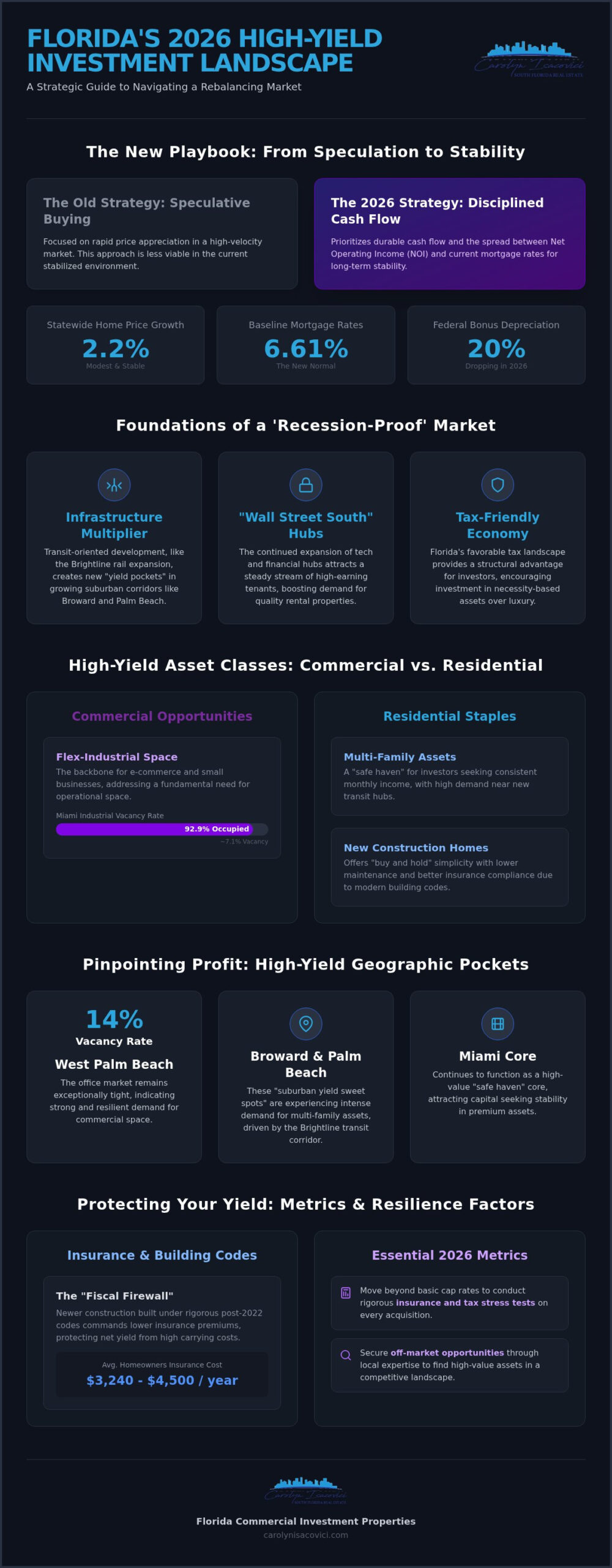
Is it still possible to find a high yield investment property in Florida when insurance premiums are climbing and competition for turnkey assets feels relentless? You aren’t alone if you’ve felt a sense of caution lately. With the statewide home price growth projected at a modest 2.2 percent and federal bonus depreciation dropping to 20 percent in 2026, the strategy for success has fundamentally changed. It’s no longer about following the crowd; it’s about identifying where the actual value resides in a rebalancing market.
We’re here to transform that uncertainty into a clear strategic advantage. This article promises to guide you through the specific sectors and geographic corridors, such as the resilient West Palm Beach office market with its tight 14 percent vacancy rate, that are delivering the highest yields right now. You’ll gain a professional framework for evaluating acquisitions while understanding the critical yield differences between commercial and residential assets in this new environment.
We will examine the impact of 2026 legislative shifts, including the new protected series LLCs and enhanced flood disclosures, to ensure your portfolio remains both compliant and profitable. By the end of this guide, you’ll have the insight needed to navigate these cycles with the confidence of a seasoned partner.
Key Takeaways
- Learn why the 2026 market favors disciplined cash-flow accumulation over speculative buying and how to pivot your strategy for long-term stability.
- Discover how to identify a high yield investment property Florida by comparing traditional multi-family assets with high-performing emerging sectors like flex-industrial.
- Explore strategic geographic corridors from Miami’s high-value “safe haven” core to the suburban yield sweet spots found throughout Broward and Palm Beach.
- Master the essential 2026 performance metrics, moving beyond basic cap rates to conduct rigorous insurance and tax stress tests on every potential acquisition.
- Understand why securing off-market opportunities through local expertise is the most reliable path to finding high-value assets in a competitive landscape.
The 2026 Florida Investment Landscape: Beyond the Migration Boom
The era of speculative “easy wins” in the Sunshine State has evolved into a more sophisticated, data-driven environment. While the frantic migration peak of 2022 has subsided, the market in 2026 offers something far more valuable for the disciplined investor: stability. Finding a high yield investment property Florida today requires a shift in perspective. We no longer look solely at rapid price appreciation, which is currently hovering around 2.2 percent statewide. Instead, we focus on the spread between net operating income and the 6.61 percent mortgage rates that have become the new baseline in August 2026. High yield now means durable cash flow that can withstand market fluctuations.
Why is the sentiment so optimistic among seasoned pros? It’s because the state’s growth is now anchored by three immovable pillars. First, massive infrastructure projects are redrawing the map of profitability. Second, the expansion of tech and financial hubs in the “Wall Street South” corridor continues to attract high-earning tenants. Finally, Florida’s overall economic landscape remains one of the most tax-friendly in the nation, providing a structural advantage that few other states can match. This has led to a “recession-proof” mantra where investors prioritize necessity-based assets over luxury fluff.
The Infrastructure Multiplier: The Brightline and Beyond
Transit-oriented development is the quiet engine driving 2026 yields. The continued expansion of the Brightline rail service has fundamentally changed how people live and work on the East Coast. We’re seeing new “yield pockets” emerge within a ten-mile radius of these transit hubs. As workers seek relief from the high costs of Miami’s core, they’re moving north into Broward and Palm Beach counties. This shift is driving intense demand for residential multi-family assets in areas that were once considered sleepy suburbs. When you align your portfolio with these transit corridors, you aren’t just betting on a building; you’re betting on the literal path of progress.
Market Resilience: Navigating Insurance and Climate Factors
It’s time for a calm, realistic look at the insurance conversation. While average homeowners insurance costs range from $3,240 to $4,500 per year in 2026, the market is finally showing signs of stabilization. Tort reforms passed in previous years are now bearing fruit, with some insurers actually filing for rate reductions. The key for a high yield investment property Florida is a “flight to quality.” Newer construction, built under the state’s rigorous post-2022 building codes, often commands significantly lower premiums and higher occupancy rates.
Modern building codes in 2026 act as a fiscal firewall, reducing insurance premiums while ensuring structural longevity in a changing climate. By focusing on assets that meet these enhanced standards, you’re not just protecting the physical structure. You’re protecting your net yield from the erosion of high carrying costs. This strategic focus on resilience is what separates the casual buyer from the professional investor in 2026.
Identifying High-Yield Asset Classes: Commercial vs. Residential
Choosing between commercial and residential assets requires a clear understanding of your risk tolerance and income goals. In 2026, the landscape has bifurcated. While residential multi-family remains a “safe haven” for those seeking consistent monthly checks, commercial sectors are offering specialized opportunities for those willing to look beyond traditional office space. For instance, the medical and wellness sector remains a high-demand niche, and Healthcare Biz Brokers, Inc. specializes in facilitating the valuation and sale of these healthcare-related businesses. Experienced seekers of a high yield investment property Florida are also currently eyeing “Flex-Industrial” spaces. These versatile units serve as the backbone for small businesses and e-commerce startups, maintaining an industrial vacancy rate of approximately 7.0-7.2 percent in Miami. This sector often outperforms luxury assets because it addresses a fundamental need for operational space rather than discretionary lifestyle spending. For a comprehensive look at how these dynamics translate into measurable returns, our analysis of Florida commercial property investment returns across key sub-markets provides the cap rate benchmarks and regional data you need to evaluate each sector with confidence.
New construction homes also remain a staple for passive investors. They offer a “buy and hold” simplicity that older assets can’t match, especially when you consider the lower maintenance costs and modern insurance compliance. According to a recent Florida TaxWatch forecast, long-term population growth continues to fuel demand for workforce housing. This is where the true resilience lies. While the luxury market can be volatile, the demand for high-quality, attainable housing for Florida’s growing workforce provides a durable foundation for your portfolio.
Commercial Real Estate South Florida: Retail and Industrial Trends
The “Last Mile” delivery phenomenon has turned industrial hubs in Miami and Fort Lauderdale into yield powerhouses. Businesses need to be closer to their customers than ever before. Interestingly, neighborhood retail centers across the South Florida corridor are showing remarkable resilience. These centers provide essential services that internet shopping can’t replace, maintaining high occupancy rates in established communities from Hollywood to Jupiter. For a deeper dive into these specifics, explore our Florida Commercial Real Estate: 2026 Investor’s Guide. If you’re ready to explore these sectors, partnering with an investment-focused brokerage can help you uncover the right entry point.
Residential Multi-Family: The Cash Flow King
Multi-family assets, particularly duplexes and triplexes in Broward County, continue to be the primary vehicle for cash flow. With a multi-family vacancy rate of 6.6 percent in Miami, the rental market remains tight enough to support healthy yields. Many investors are successfully utilizing the BRRRR method (Buy, Rehab, Rent, Refinance, Repeat) to build equity rapidly. The secret to finding a high yield investment property Florida in established Miami neighborhoods is targeting “value-add” opportunities. These are properties that need cosmetic updates or better management to reach their full market potential. By identifying buildings with below-market rents or underutilized square footage, you can create a margin of safety that protects your investment while securing a steady income stream. This regional demand also supports a thriving hospitality sector, where luxury properties like those within the Koosh Collection in Hollywood set the standard for high-end asset performance.
Strategic Geographic Pockets: From Miami to the Space Coast
Where should you place your capital to ensure the best risk-adjusted returns? While many investors fixate on the same few cities, the real opportunity in 2026 lies in the strategic corridor stretching from the Miami core up to the Space Coast. Miami remains the “safe haven” for international and institutional capital, offering a level of liquidity that few global markets can match, supported by mission-critical facilities like 3EX Hosting. However, the search for a high yield investment property Florida often leads us slightly north. Broward and Palm Beach counties have become the sweet spot for suburban multi-family yields, especially as the CBRE 2026 U.S. Real Estate Market Outlook highlights the continued strength of the South Florida commercial and residential sectors.
West Palm Beach stands out with an office vacancy rate of just 14.0 percent, the tightest in the state. This commercial stability creates a halo effect for nearby residential assets. As workforce demand remains high, the pressure on existing inventory ensures that well-located multi-family units stay occupied with minimal concessions. It’s a balanced environment where the seasoned navigator sees not just a building, but a piece of a thriving economic engine. We don’t just look for growth; we look for the kind of stability that protects your bottom line during market shifts, including specialized niches like luxury automotive real estate where Robert Zinzell offers expert market insight.
The Rise of the Treasure Coast: Port St. Lucie and Stuart
Why has Port St. Lucie become a primary destination for high yield investment property Florida? The answer is simple: population overflow. As South Florida’s cost of living pushes families further north, the Treasure Coast has transformed from a quiet region into a primary growth engine. New construction homes in Port St. Lucie and Stuart offer lower entry points than Miami, yet they maintain high rent-to-price ratios that are increasingly rare elsewhere. Investors in Stuart and Palm City are finding that new development homes provide the modern amenities and storm resilience that today’s tenants prioritize, all while keeping insurance and maintenance costs predictable.
Melbourne and the Space Coast: A Tech-Driven Yield Play
Can a region’s economy be truly resilient? The Space Coast is making a strong case for it. With the aerospace and defense industries booming, Melbourne and Palm Bay are experiencing a tech-driven rental demand surge that shows no signs of slowing. The current lack of existing inventory has created a massive opportunity for new builds. High-earning professionals in the engineering and tech sectors are looking for quality housing, and they’re willing to pay a premium for it. This makes the region a favorite for those looking to diversify their real estate portfolios with assets that aren’t tied solely to tourism, providing a steady path forward for your capital.
While the East Coast attracts significant attention, Southwest Florida remains a premier destination for residential investment. By working with specialists like Team239, investors can access professional expertise in residential properties and new construction deals across the Gulf Coast. This allows for a balanced portfolio that captures growth from both of Florida’s primary coastal corridors, ensuring long-term resilience against localized market shifts.
Calculating Real Returns: Performance Metrics That Matter in 2026
How do we measure success when interest rates have established a new baseline? In August 2026, with the 30-year fixed mortgage rate at 6.61 percent, the metrics we used three years ago no longer tell the full story. Finding a high yield investment property Florida today requires moving beyond the basic cap rate to focus on Cash-on-Cash returns. This metric is your ultimate truth-teller because it measures the actual cash flow earned on the specific amount of capital you’ve deployed. It accounts for debt service in a higher-rate environment, giving you a clear view of your actual monthly income. For a deeper dive into these calculations, see our How to Evaluate Investment Property in Florida: A Strategic 2026 Guide.
We also have to consider the “Exit Cap Rate” with a steady hand. In a stabilizing market where statewide price growth is projected at 2.2 percent, we don’t rely on aggressive market heat to bail out a poor purchase. Instead, we build our models on conservative exit assumptions. This approach ensures that your wealth is built on the property’s performance rather than speculative hope, transforming market uncertainty into a structured opportunity for growth.
Stress-Testing Your Florida Investment
Due diligence in 2026 is an exercise in precision. We utilize a three-step stress test: verifying actual income versus pro-forma projections, auditing the insurance requirements under 2026 flood disclosure laws, and calculating the post-sale property tax reassessment. While the statewide average effective property tax rate is 0.75 percent, a new acquisition often triggers a significant jump in assessed value. Net Operating Income (NOI) is the only metric that doesn’t lie because it focuses on the property’s operational efficiency. A typical 2026 expense ratio for a professionally managed Miami multi-family property generally falls between 35 and 45 percent of gross income. To ensure every step of this process is properly covered, our investment property due diligence Florida checklist walks you through the mandatory flood disclosures, insurance audits, and tax reassessment factors that can make or break your acquisition. If you want to ensure your pro-forma is grounded in reality, consult with a specialist to review your next acquisition.
Understanding Cap Rate vs. Appreciation in 2026
Does a higher cap rate always mean a better deal? Not in a “split market” like Florida’s. A 5 percent cap rate in a supply-constrained Miami neighborhood is often a safer, more resilient play than an 8 percent cap rate in a rural area with a shallow tenant pool. In the core markets, you’re investing in liquidity and the potential for long-term appreciation that rural markets simply cannot match. We look at the “Total Return,” which combines steady yield with the equity growth provided by Florida’s resilient economic base. You can explore these regional nuances in our Cap Rate for Miami Investment Property: A Strategic 2026 Analysis. By balancing immediate cash flow with strategic location, you secure a high yield investment property Florida that stands the test of time.
Securing Your High-Yield Asset: The Role of a Strategic Broker
How do you bridge the gap between identifying a growth corridor and successfully closing on a high yield investment property Florida? In a market characterized by high competition for turnkey assets, the most valuable opportunities rarely make it to the public portals. Florida Commercial Investment Properties specializes in bridging this gap by leveraging a deep network of off-market relationships developed over decades. Having a seasoned navigator on your side means you aren’t just reacting to the market; you’re anticipating it. We transform the data points we’ve discussed, from Brightline expansion to industrial vacancy rates, into actionable acquisitions.
Local knowledge is your strongest shield against the friction of modern real estate transactions. Florida’s regulatory environment is unique, with hyper-specific zoning laws and building codes that can make or break an investment’s profitability. Whether it’s navigating the 2026 flood risk disclosure requirements or understanding the nuances of the new protected series LLC legislation, our team ensures you’re making decisions based on reality rather than projections. We approach these complex market conditions with a steady, confident hand, allowing you to invest with a sense of calm authority.
The Advantage of a Full-Service Brokerage
Florida Commercial Investment Properties provides a comprehensive suite of services that goes beyond simple transaction management. We understand that a high yield investment property Florida requires a holistic view of the asset’s lifecycle. Since 2006, Carolyn Isacovici has guided investors through various market cycles, focusing on high-value property holdings and portfolio building. Our firm assists with both residential and commercial asset selection, ensuring that every acquisition serves your broader goal of wealth preservation. We manage the transition from identifying a property to a successful closing, providing the professional authority needed to navigate South Florida’s specific regulatory landscape.
Next Steps: Your 2026 Acquisition Strategy
How does your current portfolio stack up against the 2026 growth corridors we’ve explored? Now is the time to identify gaps and reposition your capital toward the sectors delivering the highest yields. For our international and out-of-state clients, we provide the essential local perspective needed to enter the Florida market with confidence. We offer a methodical approach to asset selection that prioritizes data, timing, and strategic advantage. If you’re ready to move beyond general market observations and take decisive action, it’s time to transform your investment goals into a Florida reality with Carolyn Isacovici.
Charting Your Path to Florida Real Estate Success
Are you ready to move from observation to action? The Florida market in 2026 is no longer a game of chance; it’s a landscape designed for the strategic, well-informed investor. We’ve explored how identifying the right asset classes, such as resilient flex-industrial or transit-oriented multi-family units, provides the stability your portfolio needs. By focusing on the growth corridors stretching from Miami up through the Treasure Coast and Space Coast, you’re aligning your capital with the literal path of progress. Success today isn’t about chasing the latest headline. It’s about securing a high yield investment property Florida through disciplined analysis and local expertise.
Carolyn Isacovici has provided expert brokerage since 2006, offering a portfolio-driven approach to real estate wealth that transforms market complexity into a clear advantage. Specialized in the South Florida and Treasure Coast growth corridors, we’re here to serve as your trusted navigator in an evolving market. Your next move should be grounded in data and executed with confidence. Secure your next high-yield Florida asset with Carolyn Isacovici and begin building a more resilient financial future today. The opportunities are waiting for those who know where to look.
Frequently Asked Questions
Is Florida still a good place for high-yield investment in 2026?
Florida remains a top-tier choice in 2026 as the market shifts from a seller’s peak to a balanced environment. With over 162,000 homes listed statewide, buyers now have the leverage to negotiate favorable terms. While price growth has moderated to 2.2 percent, the state’s enduring popularity as a global hub for tourism and tropical travel—supported by services like Sunlover Travel—ensures a steady influx of high-earning professionals and visitors, maintaining a robust pipeline of demand for long-term holds.
What is considered a “good” cap rate for Florida investment property right now?
In an environment where mortgage rates hover around 6.61 percent, a “good” cap rate for a high yield investment property Florida is generally between 5.5 and 7 percent. While core Miami assets may offer tighter yields due to their high demand and lower risk, looking toward the Treasure Coast can often yield higher cash-on-cash returns for investors prioritizing immediate income over rapid appreciation.
How do Florida insurance costs impact the net yield of a property?
Insurance costs, which typically range from $3,240 to $4,500 annually in 2026, are a critical variable in your net yield calculation. However, the market is stabilizing as past legislative reforms take hold. By focusing on newer construction in areas like Jupiter or Palm Beach Gardens, you can often secure lower premiums and higher net operating income compared to older, non-compliant structures.
Which Florida cities have the highest rental demand in 2026?
Rental demand is currently strongest in the Miami core, West Palm Beach, and the high-growth corridor of Port St. Lucie. Melbourne and the Space Coast are also seeing a massive surge due to the expansion of the aerospace and defense sectors. These regions are attracting a permanent workforce that requires high-quality housing and access to essential community services; you can find out more about the specialized wellness and mental health support available for families in these growing hubs. This keeps vacancy rates low and rental rates resilient across the East Coast.
Should I invest in commercial or residential property in Florida for better yields?
The choice depends on your specific goals, but both sectors show strength in 2026. Residential multi-family in Hollywood and Fort Lauderdale offers consistent demand, while flex-industrial spaces in the Miami-Dade area provide a specialized high yield investment property Florida play. Neighborhood retail centers in Palm Beach County are also proving resilient, serving as essential hubs for local communities that internet shopping cannot replace. To benchmark your expected returns across these asset types, review the detailed 2026 strategic outlook for Florida commercial property investment returns, which covers cap rates from prime retail to emerging industrial hubs.
How does the Brightline expansion affect property values in South Florida?
The Brightline has fundamentally redrawn the map of South Florida real estate by making suburban markets more accessible to the Miami workforce. This “transit-oriented” shift has significantly increased property values in Broward and Palm Beach counties. Investors who align their portfolios with these transit hubs are seeing both higher rental demand and superior long-term appreciation potential as commuting patterns evolve.
What are the tax benefits of owning investment property in Florida?
Investors benefit from Florida’s lack of state income tax and a total homestead exemption of $51,411 for 2026. Additionally, the effective July 1, 2026, legislation allowing protected series LLCs provides a robust framework for asset protection. These tax and legal advantages, combined with an average property tax rate of 0.75 percent, make Florida one of the most efficient states for building real estate wealth.
Can I find high-yield opportunities in Miami, or is it too expensive?
High-yield opportunities definitely exist in Miami, but they require a shift toward off-market deals and value-add strategies. With a multi-family vacancy rate of 6.6 percent, the demand for quality housing remains high. By identifying properties with management inefficiencies or targeting emerging neighborhoods within the Miami-Dade area, you can still secure the competitive returns typically associated with much smaller markets.
Leave a Reply