Did you know that by August 2026, Florida homeowners insurance premiums for many properties have reached an average of $7,136 annually? It is a striking figure that can quickly erode your margins if it isn’t accounted for early in the process. You likely feel the weight of this uncertainty, perhaps worrying about hidden structural issues or the maze of local short-term rental restrictions. It is natural to seek a sense of security before committing your hard-earned capital. Can you truly mitigate these risks without losing the deal? The answer is a resounding yes.
Mastering investment property due diligence Florida is about more than just checking boxes; it is a strategic audit of an asset’s financial truth. This guide will show you how to verify your property’s value and protect your portfolio from unforeseen liabilities. We will walk through a definitive 2026 checklist that covers everything from mandatory flood disclosures to the latest regulations regarding fraudulent tenancies. By the end, you will have a repeatable process to ensure your investment hits its projected cap rates while keeping your capital safe and sound.
Key Takeaways
- Discover why the due diligence period serves as your critical window for strategic verification, providing the leverage needed to navigate Florida’s “As-Is” contracts with confidence.
- Learn how to audit seller-provided pro-formas and financial data to ensure your projected income aligns with the actual market reality of 2026.
- Master the physical side of investment property due diligence Florida by identifying specialized structural needs and interpreting the latest elevation requirements for coastal assets.
- Avoid the “open permit” trap and zoning hurdles by conducting a thorough legal review to confirm your property’s intended use is fully protected.
- Develop a clear “Go/No-Go” decision matrix that transforms your inspection findings into powerful tools for professional price renegotiation or capital protection.
The Strategic Role of Investment Property Due Diligence in Florida (2026)
What is the true purpose of a due diligence period? It is far more than a simple exit hatch in a contract. For the strategic investor, due diligence represents a vital window of strategic verification. This is the moment where you pull back the curtain on a listing to ensure the numbers, the structure, and the legal standing align with your goals. In Florida, the “As-Is” contract is the industry standard. This means the seller isn’t obligated to make repairs, but you have the absolute right to walk away if the property doesn’t meet your standards. It makes this phase the most critical part of your acquisition.
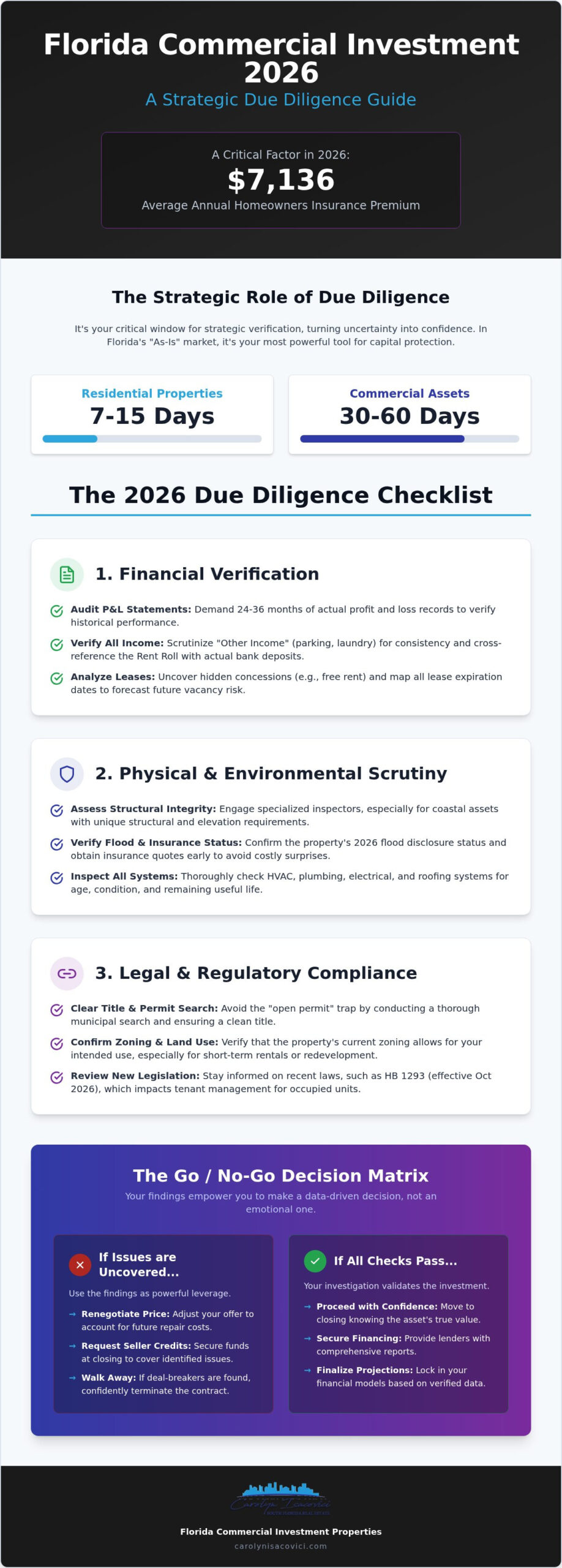
Timing is everything. In residential transactions, you usually have a 7 to 15 day window to complete your checks. Commercial assets typically offer a more generous 30 to 60 day period. Regardless of the timeline, the goal is to move from a state of uncertainty to one of absolute confidence. By using data-driven investigation, you replace “what if” with “I know.” This clarity is what allows you to commit to a closing with a steady hand.
Why 2026 Requires a New Due Diligence Standard
The Florida market in August 2026 demands a deeper level of scrutiny than in previous years. Why has the bar been raised? Legislative updates have changed the landscape significantly. For instance, the new HB 1293 law taking effect October 1, 2026, targets fraudulent residential entries, adding a layer of security for landlords but also requiring stricter tenant vetting during the acquisition of occupied units. Surface-level inspections are no longer sufficient. With insurance premiums averaging $7,136 annually, you must verify the insurability and the 2026 flood disclosure status of the asset before the period expires. This is where a professional partner becomes essential. You need someone who sees beyond the aesthetics to identify the financial and legal health of the property.
Setting Your Objectives Before the Clock Starts
How do you ensure you don’t waste precious time? You set clear objectives before the contract is even signed. Your investment property due diligence Florida process must align with your specific exit strategy. If you’re planning a short-term rental, your focus will be on local zoning and the latest municipal restrictions. If it’s a long-term hold, structural integrity and the 2026 tax assessment caps become the priority. Identifying your deal-breakers early allows you to use findings as negotiation levers rather than just reasons to cancel. It’s about having your expert team, from inspectors and financial partners like Allen Capital Funding to local brokers, on standby the moment the clock starts ticking.
Financial Verification: Auditing the Numbers Behind the Deal
How often do the numbers on a glossy listing brochure match the reality of the bank statements? Rarely. While a pro-forma offers a vision of potential, your job during investment property due diligence Florida is to uncover the historical truth. This requires a “Trust but Verify” mindset. You should demand at least 24 to 36 months of actual profit and loss statements to see how the asset performs across different seasons. It’s also vital to look closely at “Other Income” like parking, laundry, or storage fees. Are these figures consistent, or were they inflated to make the deal look more attractive? For a deeper dive into these metrics, see our guide on how to evaluate investment property Florida.
Comprehensive commercial real estate due diligence involves more than just reading a summary. It’s about auditing the paper trail to ensure the cash flow is resilient and sustainable for the long term.
The Rent Roll and Lease Audit
Is the income shown on the rent roll actually hitting the bank account? You must cross-reference monthly bank deposits with the provided rent roll to ensure every dollar is accounted for. This audit should uncover several key factors:
- Hidden concessions: Look for credits or “free rent” months given to current tenants that mask the true market rent.
- Lease expirations: Forecast upcoming vacancy risks by mapping out exactly when contracts end.
- Tenant quality: Review payment histories to identify chronic late payers or potential defaults.
If a large percentage of your tenants are scheduled to leave in the next six months, you aren’t just buying a building. You’re buying a vacancy risk that requires immediate capital. Identifying these “hidden” concessions early allows you to adjust your offer before you’re committed to the closing table, or you can leverage Koval Investments to access 0% interest funding and credit repair services that strengthen your financial position.
Expense Scrutiny and the ‘Real’ Cap Rate
Expenses in Florida are shifting. In 2026, you must account for the “Florida Tax,” which includes rising property taxes and utility costs. The average effective property tax rate in the state is 0.75%, but this varies by county. For instance, rates are around 1.00% in St. Lucie County, which impacts properties in Port Saint Lucie and Fort Pierce. To find your true return, you must calculate the cap rate for Miami investment property by dividing the verified net operating income by the purchase price. Don’t forget to compare current management fees against local market averages. If the current owner is self-managing, your projected expenses will likely rise once you hire professional help. Partnering with a seasoned investment property specialist ensures you see these financial nuances before they become costly surprises.
Physical and Environmental Scrutiny: Protecting the Asset’s Integrity
Can you trust a basic four-point inspection to reveal the true health of a multi-million dollar asset? Probably not. While standard reports cover the basics, sophisticated investment property due diligence Florida requires a deeper dive into specialized structural evaluations. In 2026, the most critical document for coastal markets is the Elevation Certificate. This determines not only your flood risk but your long-term financial viability. You should also consult Florida’s environmental regulations to ensure the property complies with the latest shoreline protection and drainage standards. This level of scrutiny transforms a potential liability into a verified opportunity.
High-ticket items deserve their own spotlight. You need to know the remaining useful life of the HVAC systems, the roof, and, for waterfront properties, the seawall. A seawall repair in Miami or Fort Lauderdale can easily reach six figures, and neglecting such hazards can increase your risk of premises liability claims, which charleslegalpl.com notes are a significant concern for property owners. By identifying these costs now, you gain a powerful negotiation lever. Similarly, while geological stability concerns are often associated with other regions, investors in the Treasure Coast and South Florida should still prioritize soil density tests for new construction or older coastal structures. It’s about ensuring the ground beneath your feet is as solid as your financial projections.
The 2026 Florida Insurance Feasibility Study
Why wait until the closing table to discover your insurance costs? With the average annual premium in Florida hitting $7,136 in August 2026, obtaining a firm quote during the due diligence period is non-negotiable. You must understand the specific “Windstorm” and “Flood” components of your policy. Some properties may even be deemed uninsurable due to outdated roofing materials or proximity to the coast. This feasibility study ensures your projected cap rates remain intact after the bills are paid. It’s about replacing anxiety with an accurate line item in your budget.
Environmental Assessments and Coastal Resilience
For commercial assets, a Phase I Environmental Site Assessment (ESA) is the gold standard for identifying past contamination. Don’t stop there. Florida’s humidity makes mold and moisture intrusion a perennial challenge. Every inspection should include a thorough check for hidden leaks or ventilation issues. For waterfront investments, evaluating seawall integrity is paramount. A failing seawall isn’t just a repair; it’s a threat to the entire structure. Taking these steps now provides the physical protection your capital deserves. It allows you to move toward closing knowing your asset is resilient and secure.
For those whose investment strategy includes high-end marine assets alongside coastal property, Preferred Yachts offers the specialized brokerage and due diligence expertise required to navigate the complexities of the yachting market.
Legal and Regulatory Compliance: Navigating Florida’s Zoning Maze
What if your perfect duplex isn’t actually a legal duplex? It happens more often than you might think. While the physical structure and the financial pro-forma might look enticing, the legal foundation of your deal rests on zoning and regulatory compliance. Effective investment property due diligence Florida requires you to confirm that the property’s current use aligns perfectly with local municipal codes. A building that has been used as a four-plex for twenty years might still be zoned for a single-family home, creating a massive liability for a new owner. You must also watch out for the “Open Permit” trap. Unclosed building permits from previous owners can haunt you, preventing future renovations or triggering fines long after you’ve closed the deal. For those seeking expert counsel on business law and corporate protection, click here to learn more about Matthew Fornaro, P.A.
Your investigation should also include a deep dive into the Preliminary Title Report. Look for easements that might limit your ability to expand the footprint or add amenities like a pool or additional parking. In the 2026 market, it’s also vital to verify that all HOA or Condo Association fees are current. With many Florida associations increasing assessments to meet new reserve requirements, you don’t want to inherit a surprise five-figure bill on day one of ownership.
Short-Term Rental (STR) and AirBnB Restrictions
Are you planning to capitalize on Florida’s tourism? If so, you must investigate local ordinances with extreme care. Hotspots like Miami Beach and Hollywood, FL, have specific, often restrictive, rules regarding short-term rentals. As of 2026, state-level preemption laws have brought some uniformity to the vacation rental landscape, but local “home rule” still allows cities to enforce registration and safety standards. Always review the “Condo Docs” for specific “right to lease” clauses. Some associations require a minimum stay of 30 or 90 days, which can instantly evaporate your projected AirBnB returns. Understanding these nuances is the difference between a high-yield asset and a legal headache.
Title, Liens, and Encroachments
Title insurance is your shield, but it only protects what is documented. A fresh survey is essential to identify “boundary creep,” where a neighbor’s fence or shed has crossed onto your lot. You should also search for municipal liens, utility debts, and unrecorded code violations that may not appear on a standard title search. These “hidden” debts stay with the property, not the previous owner. Ensuring a clear path to comprehensive title insurance is the final step in securing your capital. If you find yourself overwhelmed by these variables, seeking professional investment guidance can help you navigate the fine print with confidence.
Finalizing the Investigation: From Findings to the Closing Table
How do you transform a stack of inspection reports and bank statements into a successful closing? You synthesize the data into a “Go/No-Go” decision matrix. This is the moment where your investment property due diligence Florida efforts culminate in a clear path forward. If the physical, legal, and financial findings align with your investment thesis, you move toward the table with confidence. If they don’t, you use that data as a strategic tool for professional price renegotiation. It’s about replacing guesswork with a verified audit of the asset’s true value.
One of the most frequent debates at this stage is the “Repair Credit” versus “Seller Repair” choice. Which is safer for the investor? In the 2026 Florida market, a credit at closing is almost always the superior option. It gives you total control over the quality of the work and the choice of contractors. Seller-led repairs are often completed as quickly and cheaply as possible just to clear the inspection hurdle. By taking a credit, you ensure the asset’s integrity is maintained to your specific standards while keeping the deal moving toward the finish line.
The Negotiation Strategy
Presenting your findings to a seller requires a steady, advisory hand. Instead of a list of complaints, you present a list of verified facts. This approach transforms a potentially emotional standoff into a professional adjustment of the deal’s terms. Your broker plays a pivotal role here, maintaining deal momentum even when difficult discoveries come to light. Understanding how a seller’s agent approaches these negotiations can also be beneficial; you can explore Seller Representation with County Properties to gain insight into the professional advocacy provided to listing clients. But you must also know when to walk away. Unfixable zoning flaws or severe structural issues that threaten your capital protection are clear signals that the real opportunity lies in the next deal, not this one. A successful investor knows that “no” is often as profitable as “yes.”
Transitioning to Ownership
Once the terms are finalized, it’s time to refine your Florida commercial property investment returns forecast. You now have the actual insurance quotes, the verified 2026 tax assessments, and a clear understanding of immediate capital needs. Before you sign the final papers, perform a rigorous walkthrough to ensure the property condition hasn’t changed since your last visit. Ensure all warranties and service contracts are transferred into your name at the closing table to prevent any gap in coverage. Ready to secure your next Florida asset? Connect with Carolyn Isacovici for expert brokerage guidance.
Step Into Your Next Florida Opportunity With Confidence
How do you move from initial interest to successful ownership with absolute peace of mind? You rely on a process that prioritizes clarity over guesswork. We’ve explored how a rigorous financial audit, environmental scrutiny, and legal verification form the bedrock of a successful deal. By mastering investment property due diligence Florida, you aren’t just avoiding pitfalls; you’re actively positioning your capital for long-term resilience in the 2026 market.
Success in this evolving landscape requires more than just a checklist. It demands a partner who understands the nuances of high-yield Miami and South Florida markets. Whether you’re navigating new construction or commercial assets, having a strategist by your side ensures every finding is interpreted through the lens of your specific goals. This level of insight transforms uncertainty into a distinct competitive advantage for your portfolio.
Additionally, protecting your real estate holdings through proper legal structures is a key part of long-term wealth management. To ensure your assets are shielded and your legacy is preserved, you can visit Flex Legal, PLLC for specialized estate planning and probate law support.
Secure your Florida investment with a seasoned brokerage partner who provides comprehensive end-to-end support and strategic 2026 market analysis for every client. The path to a high-performing portfolio is paved with informed, data-driven decisions. Take that first step today and watch your vision for Florida real estate become a rewarding reality.
Frequently Asked Questions
How long is the typical due diligence period for an investment property in Florida?
In Florida, the timeline depends on the asset type. Residential contracts typically allow for a 7 to 15 day inspection window. Commercial deals generally offer a more extensive 30 to 60 day period. This duration is negotiated at the time of the offer. It’s your essential window to perform a deep dive into the property’s health without financial risk.
Can I cancel a Florida real estate contract during the due diligence period for any reason?
Yes, the standard “AS-IS” residential contract allows you to cancel for any reason before the inspection period ends. It provides you with a “sole discretion” right to terminate the deal if you aren’t satisfied. This flexibility is designed to protect your capital. Just ensure your written notice reaches the seller before the clock runs out to secure your deposit.
What is the difference between a residential and commercial due diligence checklist in Florida?
While both require scrutiny, the scope varies significantly. Residential investment property due diligence Florida focuses heavily on structural integrity and local short-term rental ordinances. Commercial checklists go deeper, requiring financial audits, Phase I environmental site assessments, and tenant estoppel certificates. Each path requires a tailored strategy to ensure you’re buying a resilient asset rather than a hidden liability.
Is a Phase I Environmental Assessment required for all Florida investment properties?
No, a Phase I Environmental Site Assessment is not mandatory for every deal. It’s a standard requirement for commercial properties to protect against future liability for contamination. For residential investments, it’s rarely performed unless the land had a previous industrial use. Your broker can help you decide if this extra layer of protection is necessary for your specific acquisition.
What happens to my escrow deposit if I find a major issue during due diligence?
Your escrow deposit remains protected as long as you act within your contract’s timelines. If you discover a major issue and choose to cancel during the due diligence period, you’re entitled to a full refund of your deposit. This is why tracking your deadlines is so vital. It’s the mechanism that ensures your capital stays safe while you investigate the deal’s truth.
Why is an elevation certificate so important for Florida property due diligence in 2026?
An elevation certificate is crucial because it directly impacts your bottom line through insurance premiums. In August 2026, Florida homeowners insurance averaged $7,136 per year, with flood components being a major variable. This certificate verifies the property’s height relative to flood zones. Without it, you can’t accurately forecast your cap rate or ensure the asset remains insurable in the long term.
Does the seller have to fix everything found during a Florida property inspection?
No, a seller is not legally obligated to make repairs under a standard “AS-IS” contract. However, you can use your inspection findings as a powerful tool for negotiation. Many buyers successfully secure a “repair credit” at the closing table to cover the costs of necessary fixes. This allows you to maintain control over the repair quality after you take ownership.
How do I verify the zoning of a potential investment property in Miami?
To verify zoning in Miami, you should consult the Miami 21 zoning code or the city’s interactive GIS maps. These tools show the specific land-use designations that impact your investment property due diligence Florida process. It’s also wise to contact the municipal planning department directly. They can confirm if your intended use, such as a short-term rental, is legally permitted on that specific lot.
Leave a Reply